Top Retail Lighting Suppliers for Global Buyers?
Choosing the right Retail Lighting supplier involves more than comparing prices or browsing attractive product images. Global buyers need dependable performance, clear documentation, and support after installation. A bright showroom can still fail when glare hides product details, color shifts across displays, or controls cannot match regional electrical systems.
Lighting designer James R. Benya describes the discipline simply: “Lighting is both a science and an art.” That balance matters in retail environments. Science guides beam angles, color rendering, energy use, thermal control, and photometric accuracy. Art shapes customer movement, product focus, and the emotional tone of a store. Experienced suppliers should provide test reports, CRI and CCT data, warranty terms, replacement policies, and relevant safety certifications. They should also understand voltage differences, local installation practices, and international shipping risks.
This guide examines leading Retail Lighting suppliers through a practical buyer’s lens. It considers product consistency, customization, technical service, lead times, and long-term operating value. Some suppliers look impressive on paper. Reality may be less polished. Sample fixtures can outperform bulk shipments, and promised delivery dates can change without warning. Buyers should request production samples, inspect packaging, and verify performance before placing large orders. That extra step feels slow. It often prevents expensive mistakes.
The strongest supplier is not always the cheapest. It is the one that communicates clearly, proves its claims, and adapts responsibly to each market. That standard deserves careful comparison.
What Defines a Leading Retail Lighting Supplier?
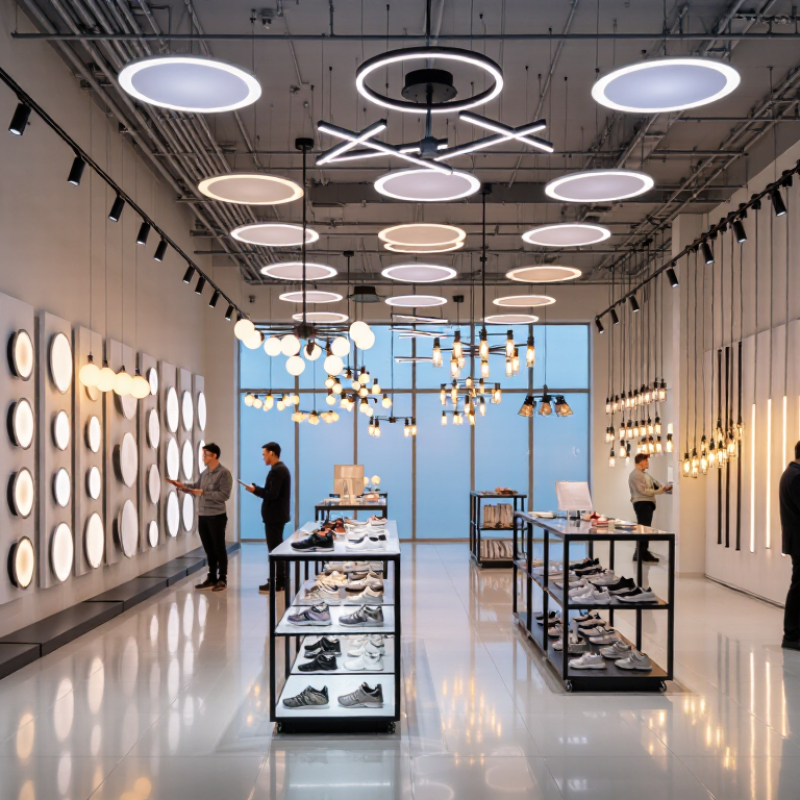
A leading retail lighting supplier does more than ship fixtures. It understands how light affects shopping behavior, product color, and staff comfort. Experienced suppliers ask about ceiling height, aisle width, display materials, and local power conditions. They use photometric data, mock-ups, and on-site testing before recommending a system. This practical process reduces glare, dark corners, and costly replacements. Still, no supplier predicts every result perfectly. Store layouts change. Human judgment remains necessary.
Professional expertise also appears in documentation. A reliable supplier provides clear specifications, tested performance data, installation guidance, and realistic delivery schedules. It explains color rendering, beam angles, flicker risk, controls, maintenance access, and expected service life without hiding limitations. Products should support applicable safety and energy requirements in each market. Independent testing and traceable quality checks strengthen credibility. Support after delivery matters too. Fast answers are useful, but accountable answers matter more. Ask who handles defects, how spare parts are stocked, and whether technicians can solve problems remotely.
Tips:
Request a sample installation. Compare light levels at shelf height, not only on drawings. Check packaging, labeling, and instructions. Record measured results. They may expose weak assumptions. Also, ask for references from similar retail projects, while remembering that one successful store does not guarantee the same outcome elsewhere.
How Retail Lighting Suppliers Are Classified by Product and Market
Top Retail Lighting Suppliers for Global Buyers?
How Retail Lighting Suppliers Are Classified by Product and Market
Retail lighting suppliers are often classified by the products they provide. Some focus on track lights for flexible store layouts. Others produce linear systems, pendant fixtures, cabinet lights, or outdoor luminaires. Display lighting usually prioritizes narrow beams and high color rendering. General lighting needs broader coverage and controlled glare.
Product claims should be checked against photometric files, color-rendering data, and test reports. A bright fixture is not always a useful fixture. Poorly controlled light can create reflections on glass shelves. It may also make merchandise look flat. I have found that sample testing under real store conditions reveals problems that catalogs rarely show.
Suppliers are also divided by market focus. Fashion retailers may need adjustable accent lighting and premium finishes. Grocery stores often require efficient, durable systems for long operating hours. Convenience stores usually value fast installation and simple maintenance. Global buyers should also compare suppliers by project scale, customization, service capacity, and regional compliance experience.
Ask about beam angles, color consistency, replacement parts, packaging, and lead times. Confirm whether the supplier provides installation guidance and after-sales support. One missed detail can delay an entire store opening. A polished sales presentation is not enough. A supplier may offer excellent products but weak communication across time zones. That weakness deserves attention.
Which Regions Host Major Retail Lighting Manufacturers?
China remains the largest manufacturing base for retail lighting, supported by deep component supply chains and high-volume export capacity. Mordor Intelligence’s 2024 LED Lighting Market report identifies Asia-Pacific as the leading regional market. China, Vietnam, and India offer strong production networks for luminaires, drivers, and smart controls.
Europe remains important for engineering-led manufacturing. Germany, Italy, Poland, and the Netherlands supply architectural fixtures, track systems, and energy-efficient commercial products. The European Commission reports that LED products can reduce lighting electricity use by up to 80% compared with older technologies. However, certification, labor costs, and shorter production runs can raise purchasing prices. The map is not perfectly clean.
North America combines domestic manufacturing with regional assembly in Mexico. This structure helps suppliers shorten delivery times for buyers in the United States and Canada. The U.S. Department of Energy’s 2023 Solid-State Lighting report notes that LED efficacy and connected-lighting performance continue to improve. That matters in retail, where glare control and accurate color rendering influence customer experience. Yet, some supplier claims still need careful testing.
Tips: Ask factories for recent photometric files, test reports, and production samples. Compare lifetime ratings at the stated operating temperature. Check driver availability before approving a large order. A factory location alone does not prove supply reliability; examine component sourcing, inspection records, and replacement support.
How Global Buyers Evaluate Supplier Quality and Reliability
Global buyers judge retail lighting suppliers beyond price. Reliability starts with measurable performance. The International Energy Agency reports that lighting uses about 15% of global electricity. Small efficiency losses become expensive across thousands of stores.
A serious supplier should provide LM-80 and TM-21 data for LED lifetime claims. Buyers should also request IEC 60598 test records, photometric files, IP ratings, and batch-level traceability. The U.S. Department of Energy’s Solid-State Lighting research highlights reliability, color quality, and thermal management as continuing industry priorities. Ask how each fixture performs above a warm warehouse ceiling. A laboratory result alone may not reflect daily retail conditions.
Check the supplier’s production controls carefully. ISO 9001 certification helps, but it does not replace factory audits or independent testing. Request failure-rate records, warranty procedures, spare-part availability, and documented lead times. The IEA’s Energy Efficiency 2023 analysis connects efficient lighting with lower energy demand, yet poor drivers can reduce savings through early failure. That risk is easy to underestimate. A sample may look flawless. Large-volume consistency is harder. Buyers should compare five or more production samples, inspect wiring and thermal interfaces, and repeat tests after transport simulation. Suppliers that answer slowly or avoid raw test data deserve caution. My own assessment would still include room for error: forecasted lifetime, projected savings, and stated delivery dates can all change under real operating pressure.