
Why Choose LED Spotlights for Global Projects?
Global projects demand lighting that performs consistently across different climates, building standards, and operating conditions. Led Spotlights offer precise beams, low energy consumption, and flexible installation for airports, hotels, retail spaces, museums, and public facilities. A 3000K beam can create a warm hotel lobby, while a narrower 4000K beam may clarify merchandise in a busy showroom. These choices require more than attractive product photos.
James Turrell, a renowned light artist and lighting expert, said, “Light is not so much something that reveals, as it is itself the revelation.” His observation reflects an important principle: Led Spotlights should support architecture, not overpower it. Experienced project teams examine beam angles, glare control, color consistency, flicker performance, heat management, and maintenance access before approving a fixture. They also check voltage compatibility, IP ratings, dimming systems, and regional certification requirements.
Small details matter. A poorly selected 24-degree beam can produce sharp, distracting spots on a stone wall. An unsuitable housing may collect dust in a dry industrial site or fail under coastal humidity. Led Spotlights are not a universal solution. They can still create glare, uneven brightness, or unnecessary replacement costs when planning is rushed. Global procurement also involves shipping delays and inconsistent technical documentation. These weaknesses deserve honest attention. The strongest specification balances visual quality, safety, serviceability, and long-term value. For international projects, reliable Led Spotlights are chosen through testing, documented performance, and careful coordination with local professionals.
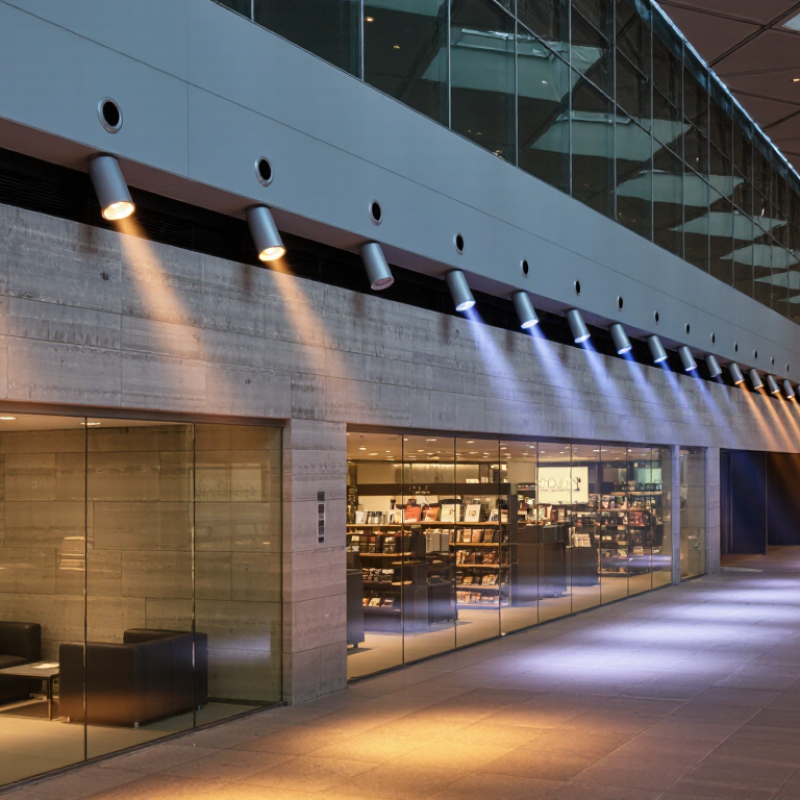
LED Spotlight Basics: 100+ lm/W Efficacy and 50,000-Hour Lifespan
For global projects, LED spotlights offer measurable performance in compact housings. The U.S. Department of Energy’s Solid-State Lighting Technology Fact Sheet reports typical LED efficacy between 80 and 150 lumens per watt. Reaching 100+ lm/W can reduce installed wattage while maintaining useful illumination. That matters in airports, retail spaces, warehouses, and remote infrastructure.
A 50,000-hour lifespan also changes maintenance planning. At twelve operating hours daily, that rating represents more than eleven years of service. The U.S. Department of Energy notes that LED life depends heavily on temperature, drivers, and operating conditions. It is not a promise of perfect brightness forever. Lumen depreciation remains important. IES LM-80 and TM-21 methods help evaluate and project LED performance more reliably.
Small details decide real results. Heat sinks need clear airflow. Drivers must match local voltage and frequency. Optical distributions should suit the mounting height, not only the product sheet. The International Energy Agency has reported that LED efficacy has passed 100 lm/W in many general-lighting applications, yet field performance can fall below laboratory values. That gap deserves attention. Dust, high ambient temperatures, unstable power, and poor installation may shorten useful life. A 50,000-hour claim is valuable, but only when project conditions support it.
Why Choose LED Spotlights for Global Projects? - LED Spotlight Basics: 100+ lm/W Efficacy and 50,000-Hour Lifespan
| Evaluation Dimension | Typical LED Spotlight Data | Why It Matters for Global Projects | Practical Selection Guidance |
|---|---|---|---|
| Luminous efficacy | 100–150 lm/W for many current commercial LED spotlight systems | Higher efficacy produces more light from the same electrical input and can reduce installed power demand. | Compare system efficacy, including the LED, optics, driver, and thermal-management losses—not LED-chip efficacy alone. |
| Rated useful life | Up to 50,000 hours is common for quality commercial products | At 12 operating hours per day, 50,000 hours represents approximately 11.4 years of operation. | Check the published L70 or L80 rating, ambient-temperature condition, and driver life instead of relying only on a headline hour figure. |
| Light-output maintenance | L70 or L80 ratings are commonly used to describe lumen maintenance | A higher maintenance level helps keep illuminance more consistent throughout the maintenance cycle. | Select a product with a lumen-maintenance report suitable for the project’s operating hours and temperature. |
| Power range | Approximately 5–60 W for many indoor and retail spotlight applications | A broad power range supports accent lighting, display lighting, hospitality spaces, galleries, and general commercial areas. | Size the wattage from target illuminance, mounting height, beam angle, surface reflectance, and spacing—not wattage alone. |
| Color temperature | Common options: 2,700 K, 3,000 K, 4,000 K, and 5,000 K | Different correlated color temperatures support different architectural, retail, hospitality, and task-lighting requirements. | Use warm white for a relaxed atmosphere, neutral white for balanced commercial spaces, and cool white where a crisper appearance is required. |
| Color rendering | CRI 80+ is common; CRI 90+ is available for color-critical applications | Higher color rendering can improve the visual appearance of merchandise, artwork, food, materials, and finishes. | Specify the required CRI and, when relevant, additional metrics such as R9 for saturated red colors. |
| Beam angle | Typical choices range from approximately 15° narrow beam to 60° wide beam | Optical control determines beam concentration, visual emphasis, spacing, and potential glare. | Use narrow beams for accents, medium beams for displays, and wider beams for general area coverage. Confirm photometric files where possible. |
| Energy-saving potential | A 50 W LED replacement for a 100 W legacy lamp can reduce lighting power by approximately 50%, subject to equivalent light output. | Lower connected load can reduce electricity consumption, cooling load, and operating costs. | Verify equivalent lumens, beam distribution, control compatibility, and local electricity tariffs before calculating savings. |
| Dimming and controls | Options may include phase-cut, 0–10 V, DALI, or wireless control, depending on the driver | Control compatibility supports daylight harvesting, scheduling, scene setting, and occupancy-based energy management. | Confirm the dimming protocol, minimum dimming level, flicker performance, wiring standard, and regional control requirements. |
| Input-voltage compatibility | Many commercial drivers support wide-range input such as 100–277 VAC; exact ranges vary by product | Wide-range drivers can simplify procurement across regions with different electrical systems. | Confirm the full voltage, frequency, surge-protection, earthing, and certification requirements for each destination market. |
| Ingress protection | Indoor models may be IP20; protected outdoor models may be IP65 or higher | The correct IP rating helps protect against dust and water exposure in the intended installation environment. | Choose the rating based on actual exposure, enclosure location, cleaning methods, and applicable installation codes. |
| Operating temperature | A typical commercial specification may be approximately −20°C to +45°C; the exact range varies | Temperature affects LED output, driver reliability, and long-term lumen maintenance. | Match the rated ambient range to the local climate, ceiling void, enclosed fixture conditions, and installation location. |
| Maintenance requirements | Long-life LED systems can reduce relamping frequency compared with many conventional lamps | Fewer lamp replacements can reduce access equipment, labor, downtime, and disposal requirements. | Include cleaning, driver replacement, spare-unit availability, and service access in the lifecycle plan. |
Note: Values shown are typical industry ranges for LED spotlight applications, not guaranteed performance for every product. Final selection should be based on the complete technical datasheet, photometric files, local electrical standards, and project-specific lighting calculations.
Related Posts
-
Essential Insights for Sourcing LED Light Logo Products Globally
-
Exploring Innovative Alternatives to Best Led Light Logo for Global Buyers
-
Exploring the Key Specifications of Smart LED Lightstrips: A Comprehensive Installation Guide for Global Buyers
-
Top Smart Lighting Products from China for Global Buyers?
-
Unlocking Energy Efficiency: Key Technical Features of Smart Lighting and How to Optimize Your Setup
-
Creative Uses of Led Lighting in Various Industries