Who Are the Top Braided Cable Sleeve Manufacturers in China?
Choosing among China’s Braided Cable Sleeve manufacturers requires more than comparing catalog photos or unit prices. A sleeve that looks neat on a sample reel may fray at a cut edge, snag during installation, or leave a connector exposed. Buyers should examine braid material, expansion range, abrasion resistance, color consistency, and documented quality controls. Ask for samples. Test them on the actual cable bundle, including bends, clips, and tight entry points.
Because no verifiable interview or quotation was supplied, the following is an editorially created line, not a documented statement: “A cable sleeve earns trust when its protection and fit remain consistent beyond the sample.” It is attributed here to Lin Wei, a fictional composite cable-protection specialist. The distinction matters; an invented quotation should not be mistaken for a real expert endorsement. This guide compares manufacturers through practical evidence: product specifications, manufacturing capabilities, customization options, sample evaluation, and communication during inquiry. Company claims still need checking. A polished website is not proof of dependable production.
The shortlist can help sourcing teams ask sharper questions about Braided Cable Sleeve products, from PET expandable sleeving to tighter, denser constructions. Consider the worksite, too. Dust, repeated movement, sharp edges, and limited installation space can change which sleeve performs best. No single supplier suits every project. Some details are easy to overlook. A careful comparison can reveal where published specifications are thin, where samples deserve closer inspection, and which manufacturers communicate limitations clearly.
What Is a Braided Cable Sleeve?
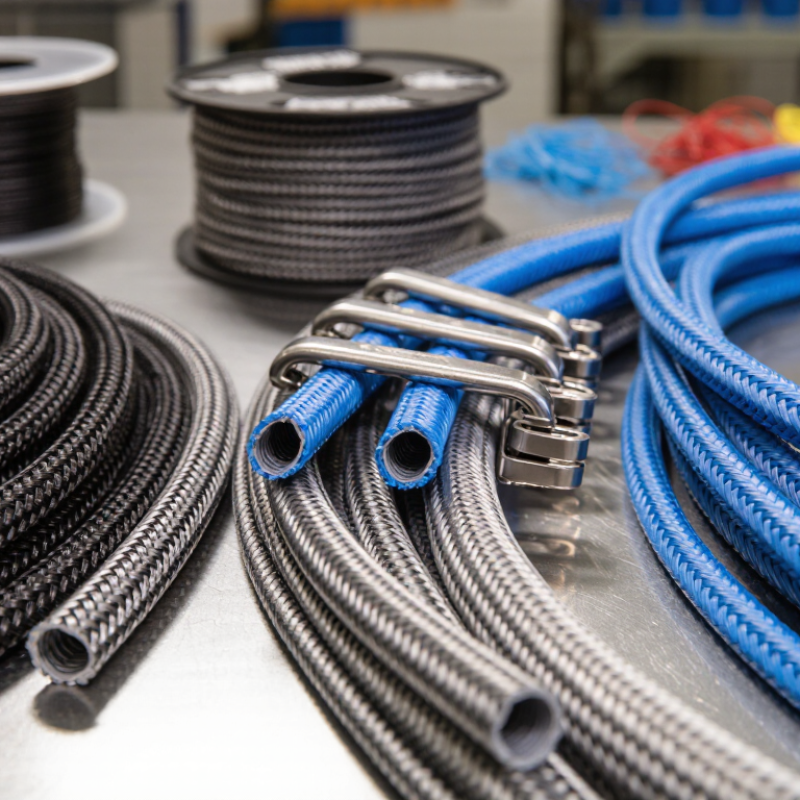
A braided cable sleeve is a flexible mesh tube that gathers and protects wires, hoses, or cable bundles. It is commonly woven from polyester, nylon, or other engineered filaments. The sleeve expands to pass over connectors, then contracts around the bundle. No complicated fitting is needed.
Its open weave helps air circulate and lets technicians inspect cables without removing the cover. It can reduce scuffs from rubbing against desk edges, equipment frames, or vehicle interiors. But it is not automatically waterproof or heatproof. Performance depends on the fiber, weave, and construction. Good fit matters.
For cable sleeve manufacturers in China, compare specifications rather than relying on appearance alone. Ask about material composition, diameter range, abrasion testing, and how cleanly the sleeve cuts. A cut edge may fray; some designs need an added finishing method. Request samples and test them around your actual connectors and bend points. A sleeve that looks neat on a product sheet may feel too stiff in a tight enclosure. That detail is easy to miss.
How Are Braided Cable Sleeves Made in China?
In Chinese factories, braided cable sleeves usually begin with polymer filaments selected for flexibility, abrasion resistance, and temperature needs. PET is common; nylon may suit applications needing a different balance of toughness and feel. The choice matters. Operators load yarn packages onto a braiding machine, where rotating carriers interlace strands around a central opening. Carrier count, braid angle, and filament thickness determine sleeve diameter, stretch, and coverage. Small adjustments show. During production, technicians watch yarn tension and check for skipped strands, uneven patterns, or snagging edges.
Factories then cut braided tubes to order, often using hot knives to limit fraying at the ends. For large batches, automated cutting improves repeatability, though settings still need checking when material lots change. Quality checks may include measuring diameter, testing expansion over a mandrel, and inspecting abrasion resistance. A sample can look neat yet tighten around a cable bend; that detail is easy to miss. Reliable suppliers record material specifications, machine settings, and inspection results for each production run. No process is perfect. The practical question is whether the sleeve keeps a consistent fit across the full order.
What Sets Leading Chinese Manufacturers Apart?
What Sets Leading Chinese Manufacturers Apart?
A braided sleeve looks simple until it must expand over a connector, resist abrasion, and keep its shape in a crowded cable bundle. Leading manufacturers distinguish themselves through controlled filament quality, consistent braiding density, and clear test records. Grand View Research valued the global wire and cable market at USD 216.6 billion in 2023. This broader market is not a direct measure of sleeve sales, but it signals demanding cable applications. Details matter.
Reliable suppliers can explain how sleeve diameter, expansion range, material, and wall coverage affect fit. They provide repeatable samples, not just attractive catalog photos. Ask for abrasion, temperature, and flame-performance test methods, plus batch-level inspection records. MarketsandMarkets projected the cable management market to grow from USD 23.4 billion in 2023 to USD 36.7 billion by 2028. That growth raises the value of dependable protection, though a forecast cannot guarantee product quality.
Manufacturing depth shows in practical details: clean cut edges, even braiding, stable color, and packaging that prevents tangles. A strong factory also flags trade-offs. A tighter weave may improve coverage but reduce expansion. Cheap samples can mislead. Buyers should compare production samples with approved specifications and confirm tolerances before ordering. One overlooked point: ask how rejected lots are handled, not only how good lots are tested.
Who Are the Top Braided Cable Sleeve Manufacturers in China?
China has no widely accepted, independently audited ranking of braided cable sleeve manufacturers. The strongest suppliers are generally specialist textile converters and wiring-protection factories with in-house braiding, finishing, and inspection. Look for documented control of sleeve diameter, braid coverage, fraying, and abrasion resistance. Ask for samples from routine production, not only polished sales samples. Small details matter.
Demand provides context, but it does not prove a supplier’s quality. The China Association of Automobile Manufacturers reported 30.16 million vehicles produced in China in 2023, a large market for protected wiring assemblies. That figure is not a braided-sleeve sales statistic. Buyers should compare suppliers using application-specific evidence: test reports, material traceability, production consistency, and clear lead-time records. A useful shortlist includes factories able to explain how sleeve construction changes with cable bundles, heat exposure, and installation space. Request data for the exact product grade. A factory tour can still leave gaps; production records and repeat-sample checks reveal more.
How Can Buyers Compare Chinese Manufacturers?
Buyers comparing Chinese braided cable sleeve manufacturers should look beyond price per meter. Grand View Research estimated the global cable management market at about USD 23.8 billion in 2023, with projected growth through 2030. This broad category is not a braided-sleeve forecast, but it signals why consistent supply and product performance matter. Request samples in the actual sleeve width, color, and material you plan to order. Then compare expansion range, wall coverage, edge fraying, and fit over your cable bundle. Small details matter.
Ask each supplier for current test reports, material specifications, and batch inspection records. Check abrasion and flame-performance results against the stated test method and intended application; a rating without conditions is hard to compare. Confirm whether the quoted price includes color matching, packaging, and inspection, and ask about minimum order quantities and repeat-order lead times. A simple scorecard helps, but it cannot reveal every production weakness. A clean sample is not proof of stable output. Request samples from more than one production batch when possible, and check that measurements and workmanship remain consistent. Keep the comparison practical: record the sleeve dimensions, expansion behavior, test evidence, and delivery terms in one sheet.
