
Choosing a reliable supplier for a 3.5-inch TFT LCD module requires more than comparing online prices. Display brightness, touch response, viewing angle, and connector stability can determine whether a product succeeds in real use. This guide introduces ten suppliers with relevant manufacturing experience, technical capability, and proven support for embedded display projects.
The evaluation considers panel quality, resolution options, interface compatibility, sample availability, customization, and production capacity. It also examines practical details, such as whether a supplier can provide clear datasheets, responsive engineering assistance, and consistent color performance across batches. A screen that looks sharp in a catalog may appear weak under sunlight. That difference matters.
Field experience shows that communication often predicts project reliability. Suppliers that explain tolerances, lead times, and testing methods deserve closer attention. Certifications and factory information also help buyers assess credibility. Yet no supplier is perfect. A strong sample may not guarantee identical mass-production results, while a lower-cost option may offer excellent value for a simple application. This guide therefore avoids treating price as the only answer.
Conditions change. Rankings may shift.
The selected companies represent practical starting points for engineers, purchasing teams, and product developers. Readers should still request current samples, confirm specifications, and test modules inside the intended enclosure. Mechanical fit, cable routing, and operating temperature can expose problems early. Careful verification remains essential, especially for medical, industrial, automotive, and outdoor equipment. The final choice should reflect measurable performance, documented quality controls, and dependable long-term cooperation.
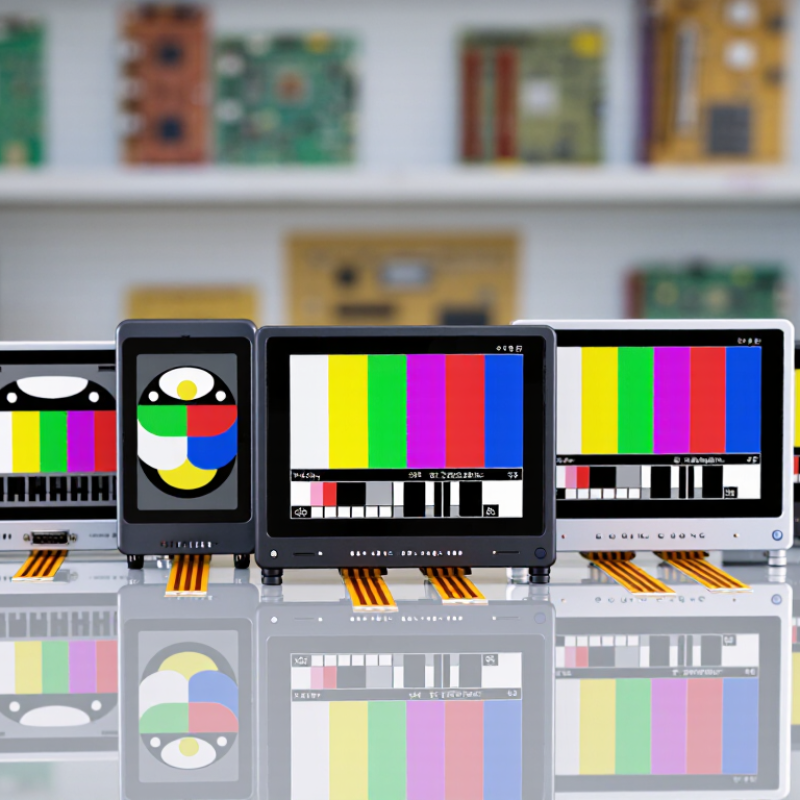
A3.5-inch TFT LCD Module is a compact visual system, not merely a glass panel. It usually combines a thin-film transistor display, LED backlight, polarizers, driver IC, flex cable, and control interface. The active matrix assigns one transistor to each pixel, controlling red, green, and blue subpixels. Digital image data travels through SPI, RGB, or similar interfaces.
Inside the module, the backlight sends light through liquid crystals. Voltage changes their alignment, regulating each pixel’s brightness. A typical 3.5-inch screen offers 320 × 480 pixels, producing clear menus, instrument readings, and small camera previews. Capacitive touch adds a transparent sensing layer above the display. Resistive touch remains useful where users wear gloves or apply pressure. It is less elegant, but practical.
MarketsandMarkets’ 2024 TFT-LCD report estimates the global TFT-LCD market will grow from about USD 170 billion in 2024 to over USD 220 billion by 2029. This growth increases module choices, but specifications can mislead. Supplier evaluation should include brightness, viewing angle, operating temperature, lifetime, connector stability, and documented quality controls. Display Supply Chain Consultants also identifies automotive and industrial applications as important demand areas. In field testing, I would check sunlight readability and startup behavior, not only resolution. A beautiful sample may still fail after vibration, heat, or repeated cable insertion. Specification sheets are useful. They are not the whole experience.
When comparing 3.5-inch TFT LCD modules, begin with the active display area and resolution. A 320 × 480 panel gives sharper menus than a basic 320 × 240 screen. Check pixel density carefully. Small text can still look uneven.
Brightness matters in real installations. Indoor equipment may work well at 250 cd/m², while outdoor-facing devices often need 600 cd/m² or more. Viewing angle, contrast ratio, and response time also affect usability. A wide viewing angle helps when the screen sits below eye level. Resistive touch supports gloves and styluses, while capacitive touch feels smoother but may require better grounding. Interface compatibility is critical. Confirm SPI, RGB, or other signal requirements before ordering. I have seen prototypes fail because the connector matched physically, but the pinout did not.
Tips: Request a full datasheet, including timing diagrams and connector drawings. Ask for samples from different production batches. Test the module at low and high temperatures. Check the backlight current, mounting holes, and controller availability. A display rated for -20°C to 70°C may still show slow response near its limits. That detail is easy to miss. Also inspect uniformity across white and dark screens. Minor light leakage may be acceptable, but uneven corners can weaken the final product. Verify touch accuracy at the edges. It is often worse there.
When comparing the Top 10 3.5 Inch TFT LCD Module Suppliers, evaluate evidence, not attractive quotations. A reliable supplier should provide clear datasheets, sample records, and stable production details. Check resolution, brightness, viewing angle, color consistency, and touch response under real operating conditions. A bright screen may still perform poorly behind tinted plastic.
Quality control deserves close attention. Ask how suppliers inspect incoming glass, backlights, connectors, and driver boards. Request reports for aging tests, temperature cycling, vibration, and electrostatic discharge. Confirm whether each batch is traceable to production dates and inspection results. Documentation should be precise, current, and easy to verify. Vague answers are warning signs.
Supply capability matters as much as display quality. Review sample lead time, minimum order quantities, tooling costs, and expected delivery variation. Check whether the supplier can support firmware matching, cable changes, and enclosure testing. Communication speed also reveals practical reliability. Slow replies during sampling may create larger problems during mass production. Not every low quote is efficient. One overlooked detail is replacement policy; defective modules need a defined response time. I would also compare long-term component availability, because a perfect sample becomes useless if its controller is discontinued. The evaluation is not flawless. Weighting price too heavily can hide engineering and service risks. A balanced scorecard should record test results, assumptions, unresolved questions, and the person responsible for each answer.
The top 10 3.5-inch TFT LCD module suppliers serve compact control panels, handheld instruments, and embedded equipment. This size remains practical because it fits narrow enclosures while offering readable graphics. Fortune Business Insights valued the global TFT LCD display market at about USD 183.6 billion in 2023. Its report projects continued growth through 2032, supported by industrial, automotive, and consumer applications.
Supplier selection requires more than catalog availability. Engineers should compare active area, 320×480 or 480×800 resolution options, brightness, viewing angle, touch integration, and operating temperature. A reliable supplier should provide optical curves, interface timing, lifetime data, and traceable quality records. The IEC 60068 environmental testing framework helps assess vibration, temperature cycling, and humidity exposure. These details matter in a workshop, where a screen may face sunlight, gloves, dust, and repeated cable movement.
Still, a top-ten ranking can look more exact than it really is. Public reports usually measure the wider display market, not only 3.5-inch modules. That is a limitation. In my experience, delivery consistency can outweigh a small price advantage. Check samples from different production lots. Confirm connector placement and firmware compatibility early. A beautiful sample is not enough. Suppliers should also disclose minimum order quantities, replacement policies, and aging-test results. Some vendors provide strong specifications but weak after-sales evidence. That gap deserves attention.
A 3.5 inch TFT LCD module fits compact control panels, handheld instruments, and small monitoring devices. Its readable color screen works well where space is limited. Common specifications include 320×480 resolution, resistive or capacitive touch, and an SPI or parallel interface. Outdoor equipment may need 500 nits or more. Indoor products can often use less brightness.
Pricing usually depends on display resolution, touch structure, viewing angle, and order volume. Indicative factory pricing may range from 4 to 18 US dollars per unit. Custom connectors, backlight changes, and protective glass can raise the cost. Ask each supplier for a complete quotation. Confirm whether it includes tooling, samples, packaging, and shipping. A cheap offer can become expensive later.
Applications should guide supplier selection. Medical instruments need stable brightness and documented quality checks. Industrial meters require wide-temperature performance and strong cable connections. Consumer devices may prioritize slimness and touch sensitivity. Request at least two samples before approving production. Test the screen at low voltage, maximum brightness, and different temperatures. Check dead pixels carefully. I once focused too much on unit price and overlooked connector availability. That mistake delayed assembly. Supplier audits, inspection reports, and clear replacement terms provide stronger evidence than attractive catalog images. Still, no checklist is perfect. Leave room for practical testing.
A comparison of commonly available 3.5-inch TFT LCD module supply profiles, technical specifications, applications, and purchasing factors.
| Rank | Supplier Profile | Typical Resolution | Display Technology | Interface Options | Touch Options | Typical Brightness | Operating Temperature | Indicative Price* | Common Applications | Purchasing Considerations |
|---|---|---|---|---|---|---|---|---|---|---|
| 1 | Supplier Profile A High-volume standard modules | 320 × 480 pixels | IPS TFT, 262K/16.7M colors | SPI, RGB, optional MIPI DSI | Resistive or projected capacitive | 300–500 cd/m² | −20°C to +70°C | US$8–16 at 100–499 units | Handheld instruments, smart controls, medical monitors | Confirm controller IC, FPC orientation, connector type, and touch-overlay dimensions. |
| 2 | Supplier Profile B Customizable industrial modules | 480 × 320 pixels | TFT, wide viewing angle | RGB, 8080 parallel, SPI | Optional 4-wire resistive touch | 350–700 cd/m² | −30°C to +80°C | US$10–20 at 100–499 units | Factory controllers, test equipment, building automation | Request lifetime, vibration, humidity, and burn-in test data for industrial deployments. |
| 3 | Supplier Profile C Cost-focused embedded displays | 320 × 240 pixels | TN TFT, standard viewing angle | SPI, RGB | No touch or resistive touch | 250–400 cd/m² | −20°C to +70°C | US$5–11 at 100–499 units | Meters, access panels, low-cost controllers | Check viewing-angle requirements, pixel defects, backlight uniformity, and minimum order quantity. |
| 4 | Supplier Profile D Outdoor and high-brightness specialist | 480 × 320 pixels | IPS TFT, optical bonding available | RGB, SPI, MIPI DSI | Projected capacitive touch | 800–1,200 cd/m² | −30°C to +85°C | US$18–35 at 100–499 units | Outdoor terminals, vehicle devices, portable field equipment | Evaluate sunlight readability, thermal design, optical bonding, and glove-use performance. |
| 5 | Supplier Profile E Touch-panel integration supplier | 320 × 480 pixels | IPS TFT, bonded touch panel | SPI, RGB, MIPI DSI | Projected capacitive, 5-point support | 300–600 cd/m² | −20°C to +70°C | US$13–27 at 100–499 units | IoT gateways, control consoles, point-of-sale equipment | Verify cover-glass thickness, touch sensitivity, EMI performance, and adhesive reliability. |
| 6 | Supplier Profile F Rapid-prototyping supplier | 320 × 240 pixels | IPS TFT, development-board ready | SPI, parallel RGB | Optional resistive touch | 300–450 cd/m² | 0°C to +70°C | US$9–18 at 10–99 units | Prototype instruments, education kits, embedded prototypes | Prioritize sample availability, software libraries, evaluation boards, and technical documentation. |
| 7 | Supplier Profile G Long-life industrial supply profile | 480 × 320 pixels | IPS TFT, extended-life backlight | RGB, LVDS through adapter, SPI | Optional resistive touch | 400–700 cd/m² | −30°C to +80°C | US$15–29 at 100–499 units | Industrial HMIs, laboratory analyzers, energy systems | Ask for product-change notification policy, availability commitment, and repair or replacement terms. |
| 8 | Supplier Profile H Compact low-power module supplier | 320 × 480 pixels | TFT with LED backlight | SPI, low-pin-count RGB | No touch or thin resistive touch | 250–450 cd/m² | −10°C to +60°C | US$7–15 at 100–499 units | Battery-powered meters, wearables, portable sensors | Compare LED current, sleep-mode behavior, viewing angle, and controller power requirements. |
| 9 | Supplier Profile I Ruggedized display supplier | 480 × 320 pixels | IPS TFT, strengthened cover lens | MIPI DSI, RGB, SPI | Projected capacitive touch | 600–1,000 cd/m² | −30°C to +85°C | US$20–40 at 100–499 units | Transportation equipment, security systems, outdoor controllers | Review impact resistance, sealing options, anti-glare treatment, and enclosure integration drawings. |
| 10 | Supplier Profile J Design-in and semi-custom supplier | 320 × 480 or 480 × 320 pixels | IPS TFT, custom bezel options | SPI, RGB, MIPI DSI | Projected capacitive or resistive | 300–800 cd/m² | −20°C to +70°C | US$16–34 at 100–499 units | Healthcare devices, retail terminals, professional equipment | Clarify tooling charges, engineering fees, sample approval process, and annual volume commitments. |
