
What Are Screw Nuts and What Types Are Available?
Screw Nuts are small threaded components, yet they control how securely many assemblies hold together. They work with bolts, screws, or threaded studs to create a removable joint. In a steel frame, a nut may endure vibration, weather, and repeated loading. In a home appliance, it may simply keep a thin panel aligned.
Industry data shows why these parts deserve closer attention. Grand View Research identifies automotive, construction, machinery, and aerospace as major demand sectors within the global fasteners market. Its market analysis also expects continued expansion through the decade, supported by infrastructure investment and industrial production. MarketsandMarkets similarly highlights rising demand for high-strength, corrosion-resistant, and lightweight fastening solutions. These reports often group nuts with broader fastener categories. That limitation matters.
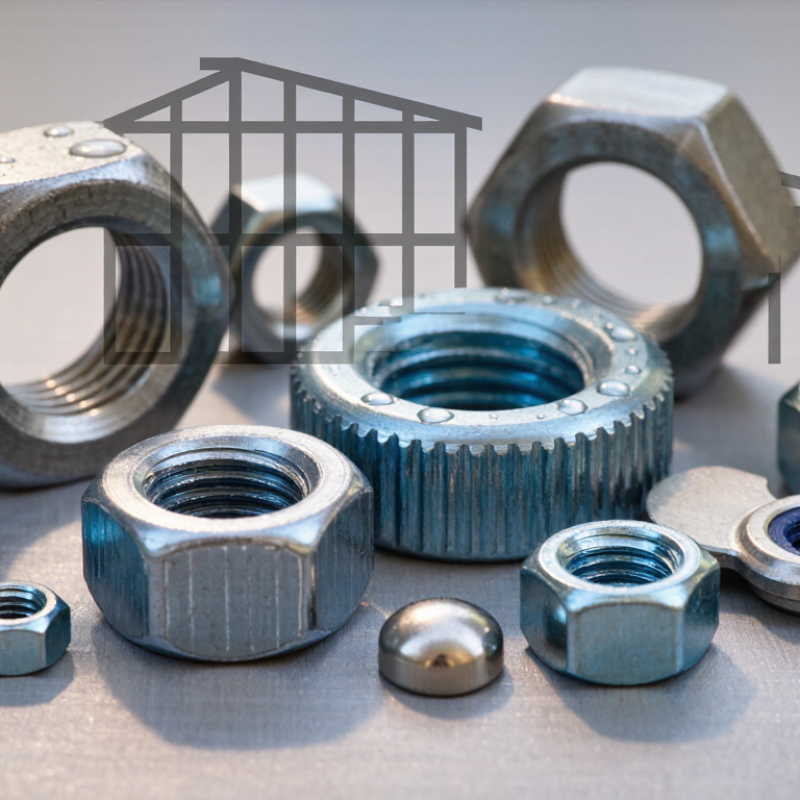
Not every nut performs the same job. Hex nuts provide familiar, general-purpose clamping. Lock nuts resist loosening under vibration. Flange nuts spread load across a wider surface. Wing nuts allow tool-free adjustment, while cap nuts cover exposed threads. Nylon-insert nuts add friction, but heat can reduce their suitability. Material choices also matter. Zinc-plated steel may fit indoor equipment, while stainless steel better serves damp environments.
The right selection depends on thread size, pitch, load, temperature, installation access, and corrosion exposure. A small mismatch can damage threads or weaken the joint. This article examines what Screw Nuts are, how their designs differ, and where each type is most useful. The subject seems simple. Real-world selection is not.
Define Screw Nuts Through ISO Metric Threads and ISO 898-2 Standards
Screw nuts are internally threaded fasteners that clamp against a bolt or screw. Their definition begins with the ISO metric thread system, not with appearance. ISO 68-1 specifies the basic 60-degree thread profile. ISO 261 lists preferred metric diameters from 1 to 100 mm. ISO 965-2 then controls tolerance limits, including common internal-thread class 6H. A nut can look correct yet fail if its pitch or tolerance is wrong.
ISO 898-2:2022 classifies nuts by mechanical properties and proof loads. Common classes include 5, 8, 10, and 12. Higher numbers generally indicate greater strength, but they do not automatically suit every bolt assembly. The required class depends on bolt grade, diameter, temperature, and applied load. In workshop inspections, thread engagement and surface damage often matter as much as the stamped class. Small errors remain expensive.
Available forms include hex nuts, lock nuts, flange nuts, cap nuts, and thin nuts. Hex nuts serve general fastening. Lock nuts resist loosening under vibration. Flange nuts spread pressure across a wider bearing area. Cap nuts protect exposed threads and reduce snagging. ISO 898-2 data should guide strength selection, while ISO 965 data should guide fit. A market analysis published in 2024 estimated the global industrial fasteners market above 80 billion US dollars, showing the scale of this ordinary component. That figure deserves caution because market boundaries differ between reports.
| Category | Dimension or Standard | Typical Data | Definition and Practical Use |
|---|---|---|---|
| Basic Definition | Function | Internally threaded fastener | A screw nut engages with an externally threaded screw or bolt to create a removable clamping connection. Torque applied to the nut produces axial preload in the fastener assembly. |
| ISO Metric Thread | Thread designation | M10 × 1.5 | M identifies an ISO metric thread, 10 is the nominal thread diameter in millimetres, and 1.5 is the thread pitch in millimetres. |
| ISO Metric Thread | Coarse-pitch examples | M6 × 1.0; M8 × 1.25; M10 × 1.5; M12 × 1.75; M16 × 2.0; M20 × 2.5 | These are commonly used coarse-pitch ISO metric thread combinations. Coarse threads generally provide faster assembly and are less sensitive to minor contamination or damage. |
| ISO Metric Thread | Fine-pitch examples | M10 × 1.25; M12 × 1.5; M16 × 1.5; M20 × 1.5 | Fine threads have a smaller pitch and provide more precise adjustment, a larger minor diameter, and improved resistance to loosening from vibration in some applications. The matching bolt and nut must have the same pitch. |
| Thread Fit | Common ISO tolerance pairing | 6H internal thread / 6g external thread | ISO metric thread tolerance classes define the permitted dimensional variation. The internal nut thread and external bolt thread must be compatible; the exact tolerance class depends on the product specification. |
| Standard Hex Nut | Common product standard | ISO 4032 | A regular hexagon nut with six external flats for installation using a wrench or socket. It is one of the most widely used general-purpose nut forms. |
| Thin Hex Nut | Common product standards | ISO 4035 and related thin-nut specifications | A reduced-height hex nut used where installation space is limited or where it serves as a jam nut. Thin nuts should not automatically be substituted for full-height nuts in high-load joints. |
| High-Style Hex Nut | Common product standard | ISO 4033 | A higher-profile hex nut that provides greater thread engagement than a standard-height nut. It is selected when additional engagement or a specific assembly geometry is required. |
| Flange Nut | Construction | Hex body with integral circular flange | The flange distributes the clamping force over a larger bearing area and can reduce surface indentation. A serrated flange may also provide a limited anti-rotation effect, subject to the application and surface condition. |
| Prevailing-Torque Nut | Construction | All-metal or non-metal insert type | This nut generates resistance to rotation that remains present when the joint is not under axial load. ISO 898-2 covers mechanical properties for applicable nuts, while prevailing-torque performance is evaluated by the relevant product or test requirements. |
| Cap or Acorn Nut | Construction | Closed end over the external thread | The closed end protects the protruding bolt thread and improves appearance. The available internal depth must be sufficient for the bolt length and any washers used. |
| Cage or Captive Nut | Construction | Nut retained in a spring cage or carrier | Used in panels, enclosures, and sheet-metal assemblies where the nut must remain positioned while the screw is installed from one side. |
| ISO 898-2 | Scope | Mechanical properties of nuts | ISO 898-2 specifies mechanical and physical property requirements for carbon-steel and alloy-steel nuts used with ISO metric coarse and fine-pitch threads, within the dimensional limits defined by the standard. |
| Nut Property Class | Common high-strength classes | 5, 8, 10, 12 | The property class indicates the mechanical performance level of the nut. Higher classes generally require higher proof-load capability, but the correct class must be selected together with the bolt class and joint design. |
| Nominal Proof-Stress Level | Property-class reference | Class 5: 500 MPa; Class 8: 800 MPa; Class 10: 1,000 MPa; Class 12: 1,200 MPa | These figures represent the nominal property-class levels commonly associated with nut classification. The actual ISO 898-2 proof-load requirement is determined by thread size, pitch, nut geometry, and the applicable standard table. |
| Lower Property Classes | Available designations | 04, 05, 6, and 9 | Lower or intermediate nut classes are available for suitable load requirements. They should be used only when their mechanical properties are compatible with the bolt, service load, tightening method, and safety requirements. |
| Typical Hex-Nut Dimensions | Across-flats width and height | M6: 10 mm / 5 mm; M8: 13 mm / 6.5 mm; M10: 16 mm / 8 mm; M12: 18 mm / 10 mm; M16: 24 mm / 13 mm; M20: 30 mm / 16 mm | These are representative dimensions for standard ISO 4032-style hex nuts, listed as nominal thread size followed by approximate across-flats width and nut height. The applicable product standard and revision should always be checked for procurement. |
| Material Groups | ISO 898-2 materials | Carbon steel and alloy steel | Steel grade, heat treatment, hardness, surface condition, and corrosion protection influence performance. Material selection should account for strength, temperature, corrosion exposure, and compatibility with the mating fastener. |
| Marking | Identification | Manufacturer mark plus property-class marking where required | Property-class markings help identify mechanical performance. Marking requirements depend on nut size, class, and the applicable standard; unmarked nuts should not be assumed to meet a specified ISO 898-2 class. |
| Compatibility Check | Selection requirements | Same nominal diameter, same pitch, suitable tolerance, compatible strength class | Before installation, verify the nut designation, thread pitch, thread fit, strength class, bearing surface, coating, and operating environment. A nut with the wrong pitch can damage the mating thread and fail to develop reliable preload. |