
How to Choose the Right Industrial Vacuum Cleaner?
Industrial environments vary, and so do the dust, debris, and liquids they produce. A machine that handles fine powder may struggle with metal chips or damp residue. Choosing an Industrial Vacuum Cleaner therefore starts with the material, not the catalogue headline.
Look closely at the work area. Is the dust combustible? Does the process create hot particles, oily swarf, or fine airborne residue? These details affect filtration, container design, hose durability, and whether wet pickup is required. Check the manufacturer’s stated airflow, vacuum pressure, filter class, and duty rating against the actual task. Numbers matter. So does the way the vacuum will be used each shift.
Consider the operator, too. A large tank can reduce emptying, but it may be awkward in narrow aisles. A compact unit is easier to move, yet frequent stops can slow production. Noise, power supply, storage space, and access to replacement filters also shape the decision. Ask suppliers for application guidance and verify claims with technical documents, not a sales description alone. If possible, test the unit using the real material and hose length. That step can reveal problems a specification sheet misses.
There is no perfect choice for every facility. Any recommendation remains provisional until it has been checked against site conditions. This guide covers the main criteria, common trade-offs, and practical questions that help match a vacuum to the job.
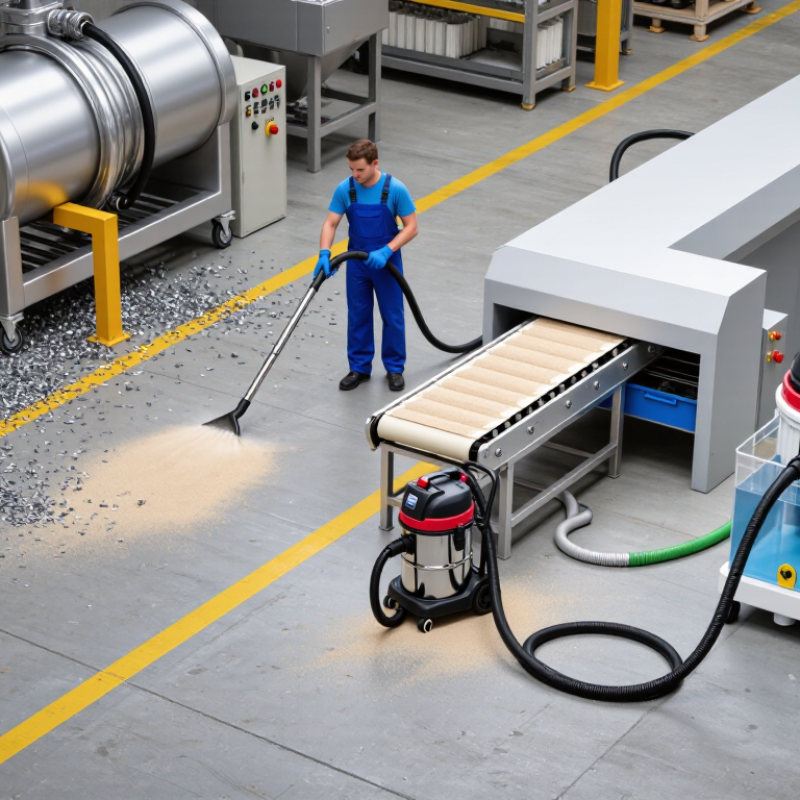
Identify the Materials and Hazards to Be Collected
How to Choose the Right Industrial Vacuum Cleaner?
Identify the Materials and Hazards to Be Collected
Start by listing everything the vacuum may encounter: fine powder, metal shavings, liquid spills, or mixed debris. A handful of dust can behave very differently from a pile of coarse chips. Note whether material is hot, sharp, damp, or likely to become airborne. Small details matter.
Check safety data sheets and ask a qualified safety professional when the substance or exposure risk is unclear. Some fine dusts need specialized collection equipment and suitable filtration; ordinary filters may allow particles to pass through. Combustible dust also requires equipment designed for the assessed hazard. Do not guess. Consider how often the material is collected, how much accumulates, and whether operators empty the bin by hand. A system that captures dust well but releases it during disposal may still create exposure.
Tips: Collect a small sample only if your workplace procedures permit it, and record its texture, moisture, and particle size. Confirm that the vacuum is rated for the material and task. If the waste stream changes, review the selection again; I would not assume yesterday’s choice still fits.
How to Choose the Right Industrial Vacuum Cleaner? - Identify the Materials and Hazards to Be Collected
| Material to Collect | Key Hazards and Conditions | Vacuum Features to Consider | Selection Notes |
|---|---|---|---|
| General dry dust and chips Examples: wood shavings, plastic granules, and ordinary workshop debris | Dust can become airborne during collection; larger chips may block narrow hoses or filters. | Choose a dry-duty industrial vacuum with suitable airflow, a durable hose, accessible filter cleaning, and a collection container sized for the expected volume. | Check the material’s particle size and quantity. Use source-capture attachments where dust is generated by machinery. |
| Fine or hazardous dust Examples: crystalline silica dust and certain toxic metal-containing dusts | Fine particles can pass through unsuitable filtration and may create serious inhalation exposure. | Use a properly sealed system with filtration and dust-containment arrangements appropriate to the substance and applicable workplace requirements. HEPA filtration may be required for the task. | Confirm the complete vacuum system—not only the filter—meets the required protection level. Follow the substance-specific exposure-control plan and filter-handling procedures. |
| Combustible dust Examples: some flour, sugar, wood, plastic, and metal dusts | A suspended cloud of combustible dust can ignite or explode if fuel, oxygen, and an ignition source are present. | Select equipment specifically approved or certified for the dust and hazardous area where required. Consider conductive or static-dissipative components, bonding and grounding, and suitable dust collection. | Do not assume a standard industrial vacuum is safe for combustible dust. Obtain a competent hazard assessment and follow applicable fire and explosion-protection requirements. |
| Metal dust or fine metal powder Examples: aluminum, magnesium, or steel grinding residues | Some metal powders can be combustible or reactive; hot particles may remain after grinding. | Match the vacuum and collection system to the specific metal, particle form, and process. Use purpose-designed equipment when the dust is combustible or reactive. | Do not collect different metal powders together unless compatibility has been confirmed. Check whether the process produces sparks or hot debris before vacuuming. |
| Liquids and wet sludge Examples: water, non-flammable coolants, and process sludge | Liquid can damage a dry-only vacuum, reach the motor, or create corrosion and overflow hazards. | Choose a wet-pickup model with compatible tank and seals, appropriate liquid filtration, and a float shutoff or other overflow protection. | Verify chemical compatibility before collecting coolants or cleaning solutions. Flammable liquids require equipment specifically designed and approved for that service. |
| Hot debris, ash, or sparks | Hot material can ignite filters, hoses, or collected dust and may damage components. | Use only equipment explicitly rated for the material temperature and application; where needed, use a suitable spark-arresting or pre-separation arrangement. | Allow material to cool unless the vacuum is designed for hot-material collection. Never assume an ordinary dust vacuum can safely collect embers or sparks. |
| Fibers or regulated hazardous materials Examples: asbestos-containing material and certain biological contaminants | Disturbance, leakage, or incorrect emptying can expose workers and contaminate surrounding areas. | Use a sealed, task-appropriate system with specified filtration, containment, and safe filter or bag change arrangements. | Follow applicable regulations and site procedures. Some materials require trained or licensed personnel and specialized equipment; a HEPA filter alone does not make a vacuum suitable. |
| Food or pharmaceutical powders | Product contamination, residue buildup, and combustible-dust risks may all be relevant. | Consider cleanable, corrosion-resistant product-contact surfaces, suitable seals, controlled discharge, and filtration appropriate to the powder. | Confirm hygiene, cleaning, and material-compatibility requirements with the site. Assess combustible-dust hazards separately where applicable. |