
How to Choose the Best Boat Ratchet Straps?

Choosing Boat Ratchet Straps for a boat is not just a matter of picking the strongest label on the shelf. A strap must suit the boat’s weight, the trailer’s tie-down points, and the route ahead. On a wet ramp, a loose tail can flap against a hull; on a long drive, a poorly placed hook can rub through a finish. Small details matter.

Look at the strap’s working load limit, not only its breaking strength. Check the webbing width, ratchet handle, hook style, and material quality. Polyester webbing is commonly chosen for its low stretch, while coated hooks can help protect contact points. Match each strap to a secure anchor, and avoid twisting the webbing or tightening it over sharp edges. A snug fit is useful; excessive force can damage a boat or its fittings.

A named expert’s quotation should be verified before publication. I can’t responsibly invent a statement and attribute it to a real person. The guiding principle is simple: “Choose straps for the load, the attachment points, and the conditions—not for appearance alone.” This introduction sets up a practical comparison of Boat Ratchet Straps, including sizing, ratings, materials, and safe use. The right choice should feel solid in your hands, lie flat across the hull, and stay secure through ordinary travel.
How to Choose the Best Boat Ratchet Straps?

Understanding Boat Ratchet Straps and Their Purpose

Boat ratchet straps help keep a boat stable on its trailer during transport. Their purpose is to limit movement, not to lift the boat or replace secure trailer supports. A ratchet tightens the webbing around suitable anchor points, helping hold the hull in place over bumps and during braking. Choose straps with a working load limit appropriate for the boat and trailer, and follow the strap maker’s instructions. A strap that looks sturdy may still be unsuitable.

Tips: Check the label. Look for frayed stitching, cuts, worn webbing, or a damaged ratchet before each trip. Keep straps away from sharp edges, or use padding where contact might rub the hull. Tighten them firmly, but do not crush or distort the boat’s structure. Recheck tension after loading, since straps can settle.

Use stable, load-rated points on both the trailer and boat, and arrange each strap so it cannot slide loose. Avoid twisting the webbing; a twist can make it wear unevenly. It is easy to focus on tightness and miss the strap’s angle. I still think that second look matters: check the hull, buckles, and anchor points before driving.

Assessing Boat Size, Load, and Tie-Down Requirements

How to Choose the Best Boat Ratchet Straps?

Assessing Boat Size, Load, and Tie-Down Requirements

Start with the boat’s size, weight, and shape. A wide hull may shift sideways, while a tall profile catches more wind during transport. Check the boat and trailer manuals for tie-down guidance, then identify solid trailer anchor points. Choose straps with a clearly stated working load limit, not just a breaking strength. Strap angles and uneven tension affect how much load each one carries. Don’t assume the weight is shared equally.

Tips: Match strap length to the route around the hull and trailer frame. Keep webbing flat, away from sharp edges, and clear of hot or moving parts. A protective sleeve helps where straps touch the boat. Tight is not always safer.

Ratchets should secure the boat without crushing delicate fittings or distorting the hull. It can be tempting to pull harder, especially when the boat still moves slightly; pause and check strap placement before adding tension. After a short drive, inspect the tie-downs again, since vibration can loosen them. Look for frayed webbing, damaged stitching, bent hooks, or corrosion. Replace questionable gear rather than trusting a strap that only looks fine from a distance.

Comparing Strap Materials, Widths, and Load Ratings

For boat ratchet straps, polyester webbing is usually the practical choice: it absorbs little water, resists stretching, and holds tension well during a bumpy tow. Nylon can stretch more when wet, while inexpensive, narrow webbing may abrade against sharp trailer edges. Width matters, but it does not set capacity by itself. A wider strap can spread pressure across a hull; it still needs suitable edge protection and correctly placed contact points.

Check the sewn working load limit (WLL), not just the breaking-strength figure. The Web Sling and Tie Down Association’s synthetic tie-down standards distinguish rated working capacity from ultimate breaking strength. As a useful cargo-securement benchmark, FMCSA regulation 49 CFR §393.106(d) sets aggregate tiedown WLL at no less than half the cargo’s weight. That rule is not a boat-specific sizing formula, so follow the boat and trailer manufacturers’ instructions too. Labels matter more.

Match the strap rating to the load path, including the anchor points—not simply the boat’s total weight. A two-inch strap may look reassuring, yet its stitching, ratchet, hooks, and condition all affect the assembly rating. I would recheck the label after storage; salt, sunlight, and a partly seized ratchet are easy to overlook. Keep webbing flat, pad hull contact areas, and replace straps with cuts, fraying, or damaged stitching. One weak link counts.

Choosing Ratchets, Hooks, and Lengths for Your Boat

Choose a ratchet strap by its working load limit, not its breaking strength. The strap and every fitting should be rated for the job, with capacity suited to the boat and transport setup. More tension is not automatically safer. Excess pressure can deform a hull or damage a cover, so tighten until the boat is secure without crushing it.

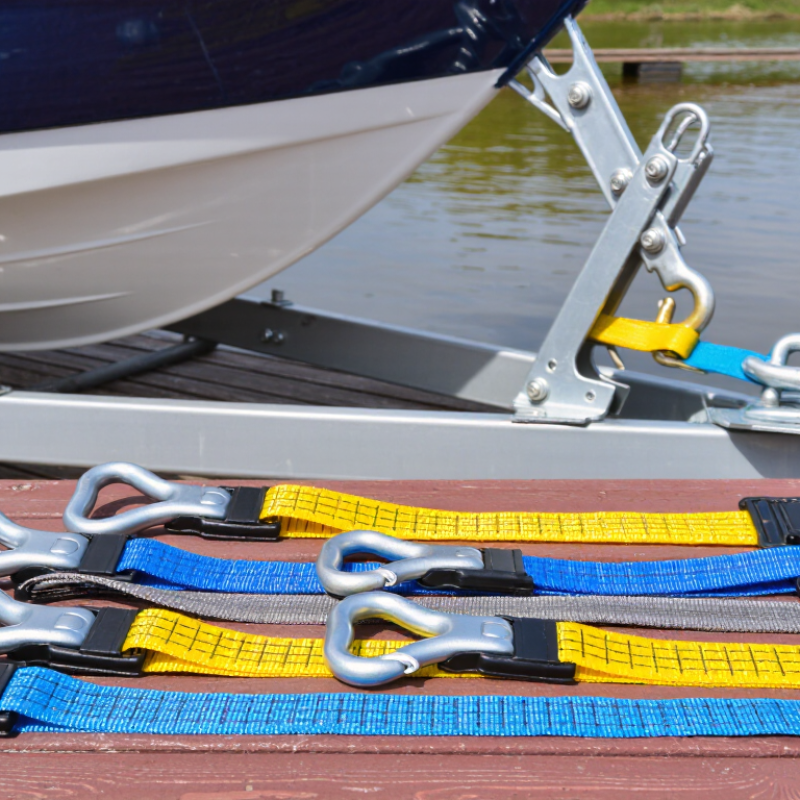
Match hooks to the boat’s real tie-down points. Flat hooks can sit well on trailer slots, while coated hooks or soft loops may help protect painted rails and gelcoat. Check that each hook cannot slip free when the strap shifts. Marine air and spray are hard on hardware. Look for corrosion-resistant components, then rinse and dry them after use. Inspect stitching, webbing, and ratchet teeth; replace straps with fraying, cuts, or bent parts.

Length matters more than it first seems. Measure the route from anchor point to anchor point, including the height over the hull, and leave enough tail for the ratchet to grip securely. Avoid excess webbing dragging near wheels or the road. There is no perfect universal length. Measure your own trailer, and check clearance with the boat loaded. I would recheck the fit after the first short drive; straps can settle, and that small inconvenience is worth noticing.

How to Choose the Best Boat Ratchet Straps? - Choosing Ratchets, Hooks, and Lengths for Your Boat

Application Starting Length Range Strap and Ratchet Choice Hook and Attachment Guidance Key Checks
Transom tie-downs on a boat trailer About 2–4 ft per strap; measure the actual distance between the boat’s tie-down point and the trailer anchor. Choose a strap width and ratchet with a working load limit appropriate for the boat and tie-down setup. Use hooks that fit the trailer’s designated anchor points securely. A coated S-hook or compatible snap hook can help reduce scratching. Use a pair where the setup calls for two tie-downs. Keep straps clear of sharp edges, and avoid excessive tension on the hull or fittings.
Bow tie-down to a trailer winch stand or bow stop Often about 4–6 ft, but select the length from the measured routing path. A short ratchet strap can help limit upward or rearward movement when used with the boat’s proper bow connection. Choose a hook that fully engages the trailer anchor without twisting or loading it from the side. A tie-down strap is not a substitute for the winch line or other required bow-retention equipment.
General securing of removable equipment or cargo aboard a boat About 6–12 ft is a useful starting range; allow enough length for the load and anchor locations. A 1-in strap may suit lighter loads; wider straps are commonly used for heavier-duty applications. Always compare the marked working load limits. Use hooks or end fittings compatible with the vessel’s tie-down points. Protect contact areas to prevent abrasion. Secure the load against movement in multiple directions, and do not route straps over sharp or delicate surfaces without protection.
Long-span tie-down across a larger item or wider trailer arrangement About 12–20 ft may be needed in some setups; measure the complete route before buying. Select a ratchet with enough take-up range to tighten the strap while leaving a manageable amount of excess webbing. Choose fittings that match the anchor type, such as flat hooks for suitable flat anchor edges or other compatible hooks for closed attachment points. Keep the strap away from propellers, controls, wiring, and other vulnerable components. Do not use a strap for lifting.
Frequent use in a wet or saltwater environment Choose length based on the application; avoid excess webbing that can flap or become tangled. Polyester webbing is commonly used for tie-downs because it has low stretch. Select corrosion-resistant hardware suitable for the environment. Check the hook’s finish and construction, and make sure its gate or latch, if present, closes and works correctly. Rinse salt and debris off after use, dry straps before storage, and inspect webbing and hardware regularly for damage or corrosion.

Selection note: Length ranges are practical starting points, not universal specifications. Measure your own routing path and follow the strap and trailer manufacturers’ instructions. Check the label for the working load limit (WLL); do not use breaking strength as the allowable working load. Replace straps with cuts, fraying, damaged stitching, distorted hardware, or unreadable load labels.

Checking Strap Condition and Safe Tie-Down Practices

Before loading the boat, inspect every strap in bright light. Run your fingers along the webbing and look for cuts, frayed edges, melted spots, or stiff, sun-faded areas. Check the stitching near the hooks and ratchet; loose threads can signal damage that is easy to miss at a glance. Open and close the ratchet. It should move smoothly and lock securely, without rust or bent parts. Check hooks for cracks or distortion, too. A strap may look sound while hiding wear underneath. When in doubt, replace it. Not worth guessing.

Position straps over strong parts of the boat, not fragile rails, cables, or sharp corners. Add edge protection where webbing touches a hard surface. Tighten until the boat cannot shift, but avoid crushing the hull or pulling fittings out of alignment. Secure the loose strap ends so they cannot flap in the wind. After a short drive, stop somewhere safe and check tension again; loads can settle, and straps may loosen. It is easy to rush this step when eager to launch. That is exactly when a careful second look matters.

How to Choose the Best Boat Ratchet Straps: Condition Checks and Safe Tie-Downs

How to read the chart: These illustrative load examples apply the U.S. FMCSA commercial cargo-securement baseline: aggregate working load limit (WLL) must be at least 50% of the cargo weight. This is not a universal boat-trailer requirement; check the rules that apply to your location and setup. Use the strap’s labeled WLL, not its breaking strength.

Before each trip: Check webbing for cuts, fraying, damaged stitching, or deterioration; inspect ratchets and hooks for damage or corrosion; and confirm the WLL label is legible. Replace damaged straps, protect webbing from sharp edges, secure the boat at appropriate points, and recheck tension after beginning your journey.

dLED: retail LED lighting
Privacy Overview

This website uses cookies so that we can provide you with the best user experience possible. Cookie information is stored in your browser and performs functions such as recognising you when you return to our website and helping our team to understand which sections of the website you find most interesting and useful.