How to Choose LED Retail Displays in 2026?
Choosing a Led Retail Display in 2026 is not simply a screen-size decision. It is a store-performance decision.
A bright panel may attract attention near the entrance. Yet poor contrast, weak content, or visible cabling can damage the shopping experience. Retail teams must examine brightness, pixel pitch, viewing distance, refresh rate, power use, maintenance access, and warranty support. The floor matters. A display facing a sunlit window needs different specifications from one installed above a dim checkout counter.
Digital signage consultant Alan Brawn offers a useful principle: “Technology should serve communication, not distract from it.” That idea deserves attention. A technically impressive Led Retail Display can still fail if shoppers cannot read its message within three seconds. I have seen displays with excellent color but confusing content. They looked expensive. They sold little.
This guide explores how to compare LED technologies, cabinet designs, installation requirements, and content workflows in 2026. It also considers practical issues, including heat, calibration, service access, and long-term operating costs. Some recommendations will depend on your store size and budget. There is no universal “best” display. That answer sounds convenient, but it is usually incomplete.
The strongest choice balances visual impact with reliable daily operation. Test samples in the actual retail environment whenever possible. Measure viewing distance. Watch customer movement. Ask whether the screen supports the message, or merely occupies the wall.
Define Retail LED Display Types and 2026 Store Applications
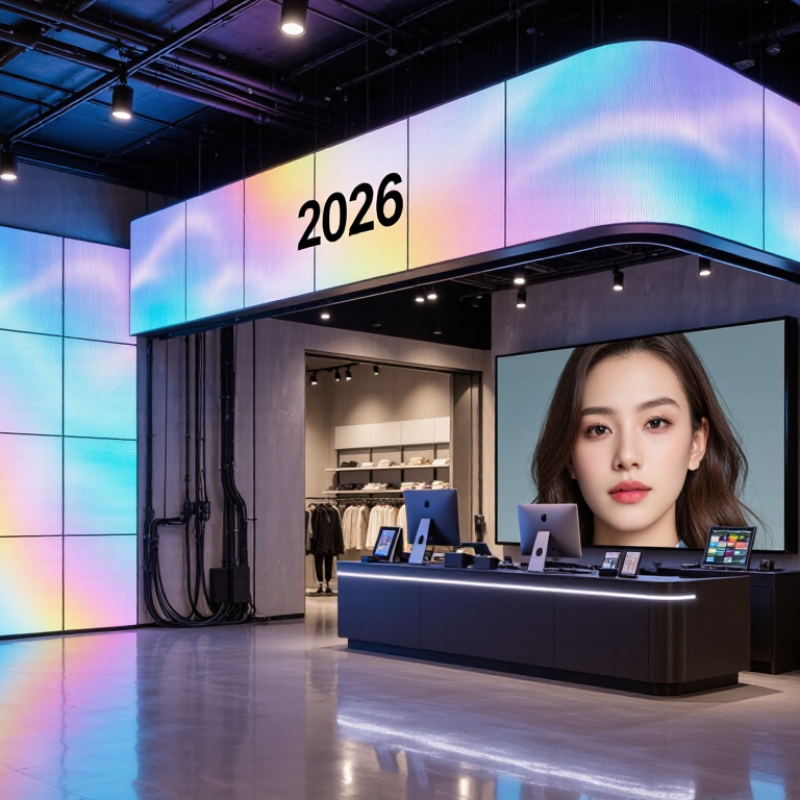
Retail LED displays will serve different store roles in 2026. Indoor fine-pitch LED walls suit flagship entrances, product launches, and immersive fashion zones. Their close viewing distance demands sharp images and stable color. A typical shopper may stand only two meters away. Small details matter.
High-brightness outdoor LED displays work better on street-facing windows and shopping center façades. They must remain readable under direct sunlight, while automatic brightness control protects customer comfort at night. Transparent LED displays can cover glass without fully blocking merchandise behind them. They fit storefront storytelling, seasonal campaigns, and limited-space retail designs. Flexible LED displays also support curved columns and unusual architectural surfaces.
Choose by application, not excitement. A compact LED poster can guide shoppers near a checkout, while a larger video wall can create a strong arrival moment. For 2026 stores, interactive displays may connect product demonstrations with QR-based information, inventory guidance, or localized promotions. Content should change by time, weather, and visitor flow. Static loops feel tired quickly.
My practical concern is maintenance. A bright screen may attract attention, but excessive brightness wastes energy and weakens the shopping atmosphere. Check pixel pitch, viewing distance, ventilation, service access, and content compatibility before purchase. I have seen attractive installations underperform because nobody planned cable routes or daily updates. Bigger is not always better. The right display feels intentional, even when it is less impressive in a showroom.
Select Pixel Pitch by Viewing Distance: 1 mm ≈ 1 m Industry Rule
How to Choose LED Retail Displays in 2026?
Select Pixel Pitch by Viewing Distance: 1 mm ≈ 1 m Industry Rule
Pixel pitch determines how clearly shoppers see text, faces, and product details. The practical rule is simple: 1 mm of pixel pitch suits roughly 1 meter of viewing distance. A 2.5 mm display usually works well from about 2.5 meters away. This guidance aligns with SMPTE’s one-arcminute visual-acuity benchmark, though store lighting and content quality also matter. The rule is useful, but not sacred.
Measure the shortest viewing distance, not the average. A customer standing 1.5 meters away may notice pixel structure on a 2.5 mm screen. For a narrow aisle, choose a 1.5 mm or finer display. For a large entrance wall viewed from five meters, a 4 mm or 5 mm option may provide better value. The 2024 Omdia LED Video Display Market Tracker identifies fine-pitch LED as an expanding category across retail and commercial environments. Still, smaller pixels increase cost, processing demands, and maintenance sensitivity. I sometimes see buyers over-specify resolution. More detail is not always more persuasive.
Tips: Measure twice. View test content at eye level. Check small product labels, skin tones, and moving footage. Use the ITU-R BT.500 viewing assessment approach when comparing brightness, contrast, and image stability. Leave room for imperfect installation angles. Real stores are rarely perfect.
Match Brightness to Lighting: 800–10,000 Nits for Retail Spaces
How to Choose LED Retail Displays in 2026?
Brightness should follow the store’s lighting, not a product specification alone. An 800–1,500 nit display often works near interior aisles with controlled, warm lighting. It can show fine product details without creating harsh reflections. Near glass doors or bright skylights, 2,000–5,000 nits may be more practical. Outdoor-facing windows can require 5,000–10,000 nits during strong daylight.
Measure the actual viewing area at different times. A screen that looks perfect at 9 a.m. may appear weak at noon. Use a light meter when possible, and check reflections from polished floors, glass shelves, and metal fixtures. High brightness is not always better. Excessive output can cause glare, increase heat, and make skin tones look unnatural. It may also raise energy use.
Content matters too. Dark backgrounds need less brightness than white layouts. Automatic dimming can respond to changing light, but sensors need careful placement. A sensor hidden behind a display frame may read the wrong conditions. That mistake is easy to miss. I have seen teams choose maximum brightness, then reduce it later because shoppers avoided the screen. A balanced setting usually feels clearer, calmer, and more trustworthy. Test the display from the real customer path, not only from directly in front.
Check Reliability: 50,000–100,000 LED Hours and IEC 60529 IP Ratings
When choosing LED retail displays in 2026, treat the advertised 50,000–100,000 LED hours as a planning estimate, not a promise. Ask what the figure means. Some suppliers measure L70, which indicates when brightness may fall to 70% of its original level. Others describe expected operating life differently. These numbers are not interchangeable.
Look for test conditions, too. Confirm the rated ambient temperature, brightness setting, daily operating hours, and maintenance schedule. A screen running at maximum brightness beside warm lighting may age faster. Poor ventilation can shorten component life. It sounds obvious, but store layouts often hide airflow problems. Request service records, thermal test data, and a written warranty. A perfect number can still mislead.
IEC 60529 IP ratings help assess enclosure protection. The first digit covers solid particles, while the second covers water. For example, IP65 indicates dust protection and resistance to water jets, but it does not mean the display can operate underwater. Indoor retail areas may need limited protection, while entrances, showcases, and semi-outdoor sites require more careful selection. Check the complete installation, including cabinets, connectors, vents, and cable entry points. One weak seal can undermine the rating. Also verify whether the rating applies to the assembled display, not only an individual module. A practical site inspection remains necessary, because specifications cannot predict every store’s heat, dust, or cleaning routine.
How to Choose LED Retail Displays in 2026?
Check reliability through a rated LED lifetime of 50,000–100,000 hours and an IEC 60529 IP rating suited to the installation environment.
Rated LED Lifetime Reference Range
The 50,000–100,000-hour range is a practical specification benchmark for LED display selection. Actual service life depends on operating temperature, brightness, duty cycle, ventilation, and maintenance.
IEC 60529 IP Rating Comparison
In an IP code, the first digit indicates protection against solid particles and the second digit indicates protection against water. IP54 means dust-protected and splash-protected; IP65 means dust-tight and protected against water jets; IP67 means dust-tight and protected against temporary immersion up to 1 metre under IEC 60529 test conditions.
Compare Total Cost, Power Use, Warranty, and Expected ROI
How to Choose LED Retail Displays in 2026?
A low purchase price can hide expensive installation, content software, mounting, delivery, and future repairs. I compare the complete three-year cost before approving a display. Ask for itemized quotes, including spare modules, control equipment, labor, and disposal. A screen using 8 kW during busy hours may consume far more than a smaller 3 kW model. Calculate power costs with your local commercial electricity rate, operating schedule, and seasonal changes. Measure brightness carefully. Excessive brightness wastes energy indoors.
Warranty terms deserve close attention. Check coverage for modules, power supplies, control cards, labor, and on-site service. A warranty that excludes installation labor may create an unwelcome bill. Also ask about response times and replacement-part availability. Dust, heat, and long operating hours can expose weaknesses quickly. I have seen a display perform well in a showroom, then require adjustments after installation. Testing conditions were too gentle.
Expected ROI should use realistic sales data, not optimistic promises. Estimate additional daily sales, gross profit, campaign frequency, and the time needed to recover the investment. Track foot traffic before installation, then compare it with sales after thirty, sixty, and ninety days. My first projection was too confident because it counted impressions as purchases. That mistake matters. Use a cautious scenario alongside the best case, and leave room for content production, electricity increases, and slower retail seasons. Small details change the result.
How to Choose LED Retail Displays in 2026? — Compare Total Cost, Power Use, Warranty, and Expected ROI
Five-year planning comparison for a 10 m² retail installation. Figures are typical market planning estimates in USD and should be confirmed through project-specific quotations, site surveys, and local electricity tariffs.