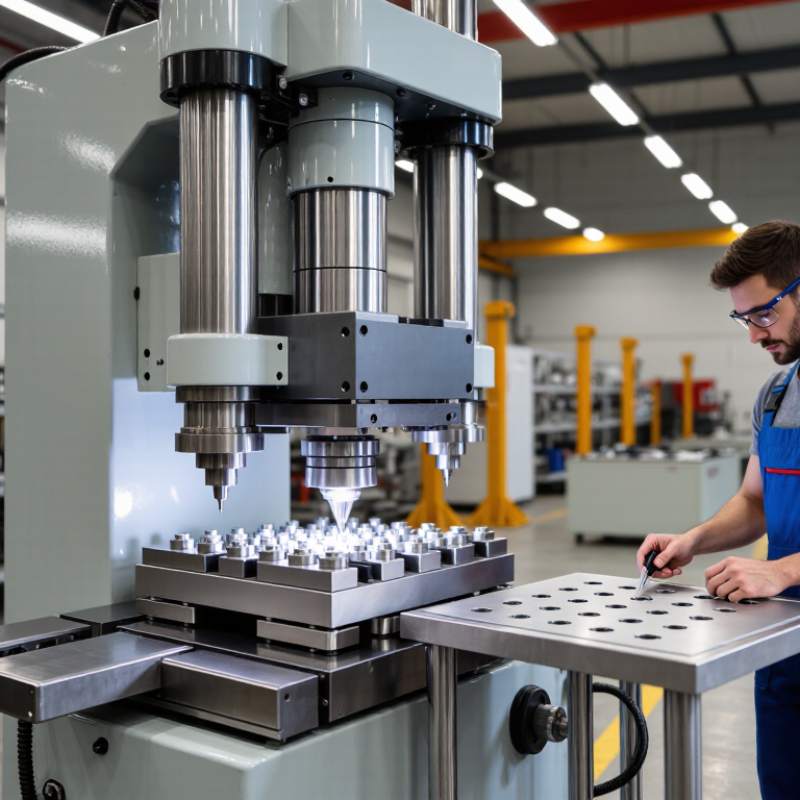
How to Choose a Pneumatic Punching Machine from China?

Choosing a Pneumatic Punching Machine from China requires more than comparing prices on a supplier website. The right decision begins with your material, hole diameter, production volume, and available air pressure. A thin aluminum sheet may need different tooling from a stainless-steel bracket. Small details matter.

Shigeo Shingo, a respected manufacturing engineer, warned, “The most dangerous kind of waste is the waste we do not recognize.” His observation applies directly to machine purchasing. A low quotation can hide weak frames, unstable pressure systems, expensive dies, or limited technical support. Look closely at punching force, stroke length, cycle speed, air consumption, and working-table dimensions. Ask for test samples using your actual material. A clear video is helpful, but it cannot replace inspection.

Supplier experience also deserves careful attention. Review factory records, quality-control procedures, spare-parts availability, and export experience. Confirm whether the machine includes guards, emergency stopping, pressure regulation, and readable operating instructions. These features protect operators and reduce avoidable downtime. Certification documents should be verifiable, not simply displayed in a sales brochure.

Do not ignore after-sales communication. Can the supplier explain die replacement clearly? Can engineers respond when pressure drops unexpectedly? These questions reveal practical reliability. I may sound overly cautious, but many buyers focus too narrowly on purchase price. That is a mistake. Calculate the complete cost, including tooling, freight, installation, maintenance, energy use, and possible production delays. A suitable Pneumatic Punching Machine should deliver consistent holes, stable operation, and predictable support throughout its working life.

How to Choose a Pneumatic Punching Machine from China?

Define Your Production Needs and Material Requirements

Choosing a pneumatic punching machine from China starts with a clear production profile. Define your required output per hour, working days, and acceptable downtime. In factory evaluations, buyers often focus on maximum force and overlook cycle speed. Record the actual number of parts produced during a normal shift. Include loading, alignment, tool changes, and inspection time. Be specific.

Material requirements need equal attention. Identify the material type, thickness range, hardness, surface finish, and sheet size. Mild steel and stainless steel can require different punching forces and tool designs. Test samples using your most difficult material, not an easy substitute. Thickness variation also affects alignment and punch life. Do not rely on a single sample. That assumption can become expensive.

Share these details with potential Chinese manufacturers and request force calculations, layout drawings, and sample results. Ask how the machine handles your smallest and largest workpieces. Confirm the control system, safety guards, spare tooling, maintenance access, and operator training. My first production estimate was too optimistic, because setup time was missing. Recheck your figures with a real operator. A modest speed target may prove more reliable than an impressive maximum rating. Review technical documents carefully, and require measurable acceptance criteria before placing an order.

Compare Pneumatic Punching Machine Types and Operating Principles

How to Choose a Pneumatic Punching Machine from China?

Pneumatic punching machines use compressed air to move a cylinder and punch through sheet material. The cylinder pushes the punch downward, while a spring or reverse air pressure returns it. This mechanism is simple, fast, and easier to maintain than many hydraulic systems. However, its force depends strongly on air pressure, cylinder diameter, stroke length, and tooling clearance.

C-frame machines offer open access around the die area. They suit brackets, panels, labels, and small metal parts. Their working area is convenient, but excessive side loading can reduce accuracy. H-frame machines provide a stiffer structure for thicker sheets and repeated production. They need more floor space. Single-cylinder models are economical for light or medium work. Double-cylinder models distribute force more evenly, especially across wider tools. Toggle-assisted designs can increase force near the end of the stroke, but their adjustment is less forgiving.

When comparing suppliers in China, ask for tested punching force, stroke, cycle speed, air consumption, and permitted material thickness. Request sample results using your actual material, not only catalog photographs. Check whether the control valve, die holder, guard, and emergency stop are clearly specified. A machine may appear powerful on paper, yet produce rough holes when the die clearance is wrong. I would also inspect frame welds and guide alignment during a factory visit or video inspection. Air quality matters too; moisture can damage valves and create unstable cycling. Small details often decide long-term reliability.

How to Choose a Pneumatic Punching Machine from China? – Compare Pneumatic Punching Machine Types and Operating Principles

Pneumatic Punching Machine Type Operating Principle Typical Applications Typical Force Range Typical Stroke Range Production Characteristics Main Advantages Important Limitations Best Selection Criteria
C-Frame Pneumatic Press Compressed air drives a pneumatic cylinder. The cylinder moves a ram and punch downward through a guided stroke, while a die supports the workpiece. Hole punching, embossing, bending, riveting, crimping, and light assembly work on sheet metal, plastics, leather, and gaskets. Approximately 0.5–20 tons, depending on cylinder size, air pressure, and machine construction. Approximately 25–150 mm; adjustable stroke and shut height are common on many models. Suitable for intermittent or repetitive operations. Cycle speed depends on stroke length, valve size, tooling, and air-supply capacity. Compact open-front design, easy loading, good visibility, and relatively simple maintenance. Less resistant to frame deflection than straight-side presses; not ideal for very high loads or highly precise multi-station work. Choose when accessibility, compact size, and general-purpose punching are more important than maximum rigidity.
Straight-Side Pneumatic Press One or more pneumatic cylinders apply force to a guided ram inside a rigid, enclosed frame. The straight-side structure reduces side movement during pressing. Higher-accuracy punching, forming, blanking, and operations requiring better alignment between punch and die. Approximately 5–100 tons in specialized pneumatic or air-over-oil configurations; capacity varies considerably by design. Approximately 50–250 mm, depending on the required forming depth and tooling. Provides improved rigidity and repeatability compared with many C-frame designs, but normally requires more floor space. Better alignment, lower frame deflection, and improved suitability for heavier tooling. Higher purchase cost, larger footprint, and more demanding installation requirements. Choose when die alignment, structural stiffness, and consistent production quality are key priorities.
Bench-Top Pneumatic Press A compact pneumatic cylinder operates a small ram mounted on a workbench or dedicated stand. The operator positions each part manually or with a simple fixture. Small holes, eyelets, labels, gaskets, terminals, rivets, and low-volume assembly operations. Approximately 0.1–5 tons. Approximately 10–100 mm. Best for low- to medium-volume work, prototypes, and flexible product changes. Automatic feeding is usually limited. Low space requirement, easy relocation, lower initial investment, and convenient manual operation. Limited force, workpiece size, automation capability, and operator throughput. Choose when the workpiece is small and the required force is modest.
Air-Over-Oil Press Compressed air moves hydraulic oil through an intensifier or air-oil cylinder. The pneumatic input is converted into higher pressing force and smoother motion. Deep forming, controlled pressing, punching of tougher materials, assembly, and applications requiring longer dwell or higher force. Approximately 5–100 tons, depending on the air-oil intensifier and cylinder configuration. Approximately 50–300 mm. Slower than a basic direct-air press in many applications, but offers improved force control and a more stable pressing phase. Higher force density, smoother pressing, better control of the working stroke, and reduced requirement for a large hydraulic power unit. More complex construction, possible oil leakage, and greater maintenance requirements than a direct pneumatic press. Choose when direct compressed-air force is insufficient or when controlled pressing is required.
Toggle Pneumatic Press A pneumatic cylinder drives a toggle linkage. Near the end of the stroke, the linkage increases mechanical advantage and can hold force briefly at the bottom position. Riveting, clinching, crimping, stamping, and operations requiring high end-of-stroke force with a relatively short working zone. Approximately 0.5–10 tons at the working point, depending on linkage geometry and cylinder size. Approximately 20–100 mm, with the highest force concentrated near the bottom of the stroke. Fast approach and strong end-of-stroke action. The available force changes significantly with ram position. Efficient force multiplication, compact design, and good suitability for repeatable end-of-stroke operations. Limited force throughout the full stroke; tooling and adjustment must match the toggle geometry. Choose when the process needs high terminal force rather than uniform force over the complete stroke.
Pneumatic Punching Machine with Strip or Coil Feeding A pneumatic press performs the punching action while a mechanical, servo, or pneumatic feeder advances strip material through the die at a preset pitch. High-volume production of brackets, terminals, washers, clips, small panels, and repetitive strip components. Approximately 1–30 tons for many light- and medium-duty applications. Approximately 20–100 mm; the required stroke depends on the die and material layout. Improves output consistency and reduces manual handling. Actual speed depends on material thickness, pitch, die design, and feeding system. Higher productivity, repeatable indexing, reduced labor, and better material utilization when properly configured. Higher system cost, more setup complexity, and greater sensitivity to strip alignment and material variation. Choose when the same part is produced repeatedly and automatic material feeding provides a measurable productivity benefit.
Multi-Head Pneumatic Punching Machine Several pneumatic cylinders or punching heads operate simultaneously or in a programmed sequence to perform multiple holes or forming actions in one fixture. Panels, covers, footwear components, filters, electrical parts, and products requiring several repeated holes. Approximately 0.2–10 tons per head, depending on the number and size of cylinders. Approximately 10–100 mm per head. Can reduce handling time and improve positional consistency, especially when all holes are processed in one clamping operation. Shorter cycle time, consistent hole spacing, and reduced risk of errors caused by repeated repositioning. Less flexible for frequent product changes; fixture and control-system design are more complex. Choose when the product geometry is stable and several operations can be combined into one cycle.
Automatic Pneumatic Punching Cell A pneumatic press is integrated with sensors, a programmable controller, part feeding, workpiece positioning, and optional unloading equipment. Continuous production lines, safety-critical repeat operations, and applications requiring traceability or minimal manual intervention. Approximately 1–30 tons for many light- and medium-duty automated cells. Approximately 20–150 mm. Offers the highest automation potential among the listed types, but line balance, sensor reliability, and tooling changeover directly affect performance. Reduced manual labor, improved repeatability, enhanced safety monitoring, and stable production data. Highest integration cost, more complicated troubleshooting, and greater dependence on correct programming and maintenance. Choose when production volume, labor reduction, process consistency, and automated quality control justify the investment.

Note: Force, stroke, speed, air consumption, and dimensions are typical engineering ranges rather than fixed specifications. Actual performance depends on cylinder diameter, working air pressure, valve capacity, frame rigidity, tooling design, material thickness, duty cycle, and applicable safety requirements.

Evaluate Key Specifications, Tooling, and Machine Compatibility

Choosing a pneumatic punching machine from China starts with the part, not the advertised tonnage. A practical trial should confirm material thickness, hole diameter, pitch, and production speed. Check nominal force, stroke length, throat depth, shut height, and strokes per minute. A machine may show 30 tons, yet lack sufficient frame rigidity for thick stainless steel. Ask for force curves, repeatability records, and a video of your actual material being punched.

Tooling determines whether that force becomes clean production. Confirm punch and die clearance for each material, especially aluminum, mild steel, and stainless steel. The die should match the hole shape, edge condition, and expected burr level. Guided tooling helps reduce misalignment. Quick-change holders can shorten setup time, but they may reduce rigidity if poorly designed. Small details matter.

Air quality matters too. ISO 8573-1 provides a framework for specifying particles, water, and oil in compressed air. The U.S. Department of Energy reports that compressed air can consume about 10% of industrial electricity, while leaks may waste 20–30% of compressor output. Verify working pressure, air consumption per cycle, receiver capacity, and actual flow at peak demand. I would not trust a catalog figure alone. Connect the machine to your plant layout, voltage, controls, guarding, and maintenance skills. A factory acceptance test is useful, though it can still miss long-term wear. That limitation deserves attention.

How to Choose a Pneumatic Punching Machine from China?

Estimated punching force and recommended machine capacity for a 10 mm round hole in 2 mm sheet.

The estimated force is calculated using F = π × hole diameter × material thickness × shear strength. The recommended machine rating includes a 30% capacity reserve to account for tooling wear, material variation, clearance, and operating conditions. When evaluating a pneumatic punching machine, confirm that its rated force, working air pressure, die opening, stroke, and punch-and-die dimensions match your material and tooling requirements.

Representative shear-strength values used: aluminum 150 MPa, mild steel 250 MPa, and stainless steel 400 MPa. Actual requirements vary by alloy, temper, edge distance, tool clearance, and punch condition.

Assess Manufacturer Quality, Safety Features, and Customization Options

How to Choose a Pneumatic Punching Machine from China?

A reliable supplier should provide traceable production records, inspection reports, and clear technical documentation. Visit the workshop virtually or in person. Examine frame welding, cylinder alignment, air-line cleanliness, and component storage. Ask how operators test punching accuracy after continuous running. A polished showroom proves little. Consistent records matter more.

Safety must be checked before price. Look for guarded moving parts, emergency stops, pressure regulators, and overload protection. Two-hand controls may reduce accidental activation during manual loading. Confirm that the machine can meet safety requirements in your operating country. Request risk assessments, user manuals, wiring diagrams, and maintenance schedules. Test the emergency stop physically, not only through a video.

Customization should begin with your material and production data. Provide thickness, hole diameter, sheet size, daily cycles, and required tolerance. The supplier can then recommend tonnage, stroke length, die clearance, and feeding methods. Request sample punching with your actual material. Inspect burrs, hole distortion, noise, and cycle consistency. Ask for drawings before approval. Small changes become expensive later. I have seen buyers focus on maximum force while overlooking die replacement time. That decision deserves reconsideration. Confirm spare parts, training, warranty conditions, and final inspection procedures in writing.

Verify Pricing, Delivery Terms, Installation, and After-Sales Support

How to Choose a Pneumatic Punching Machine from China?

A low quotation can look attractive, but the cheapest offer may hide important costs. Ask for a complete price sheet. It should list the machine, tooling, control components, packing, and spare parts. Confirm whether the price includes export handling and local delivery. Request the payment schedule in writing. Milestone payments can reduce risk. Do not rely on a single chat message.

Delivery terms need equal attention. Confirm the production period, inspection date, shipping method, and port responsibilities. Incoterms should appear clearly on the quotation. Ask what happens if production is delayed. A factory should provide progress photos, testing records, and packing details. I have learned that estimated dates are not firm dates. Build extra time into your production plan.

Installation support often decides whether the machine performs well. Confirm electrical requirements, air pressure, foundation needs, and operator training. Ask whether commissioning is remote or onsite. Check the response time for technical problems. The agreement should define warranty coverage, excluded parts, and spare-part availability. Request service contacts and customer references with similar machines. A video call may reveal more than polished brochures. Still, I would verify every claim. My own preference is a written acceptance test, although I once underestimated the value of operator training. Small oversights become expensive later.

dLED: retail LED lighting
Privacy Overview

This website uses cookies so that we can provide you with the best user experience possible. Cookie information is stored in your browser and performs functions such as recognising you when you return to our website and helping our team to understand which sections of the website you find most interesting and useful.