Who Are the Best Wine Refrigerator Suppliers in China?
Choosing the best Wine Refrigerator suppliers in China requires more than comparing prices or polished product photos. The right partner must understand temperature stability, vibration control, insulation, and the needs of different wine collections. California winemaker Robert Mondavi famously said, “Making good wine is a skill; making fine wine is an art.” A refrigerator cannot create that art, but poor storage can undermine it.
Look closely at how each supplier builds and tests its cabinets. Ask about single-zone and dual-zone models, compressor performance, UV-resistant glass, shelf materials, noise levels, and temperature recovery after the door opens. Request clear specifications and evidence of quality checks, rather than relying on broad claims. Details matter. A bottle should slide onto its shelf without scraping, and the cabinet should hold a steady setting in a warm room.
A reliable comparison also covers production capacity, customization, sample orders, warranty terms, and after-sales support. Check whether the supplier can explain its test process in plain language and respond consistently to technical questions. These signs do not guarantee a perfect partnership. I would still verify claims with samples and written specifications; a neat showroom can hide practical weaknesses. This guide examines Chinese suppliers through those purchasing criteria, helping importers, retailers, and wine businesses assess fit before making a commitment.
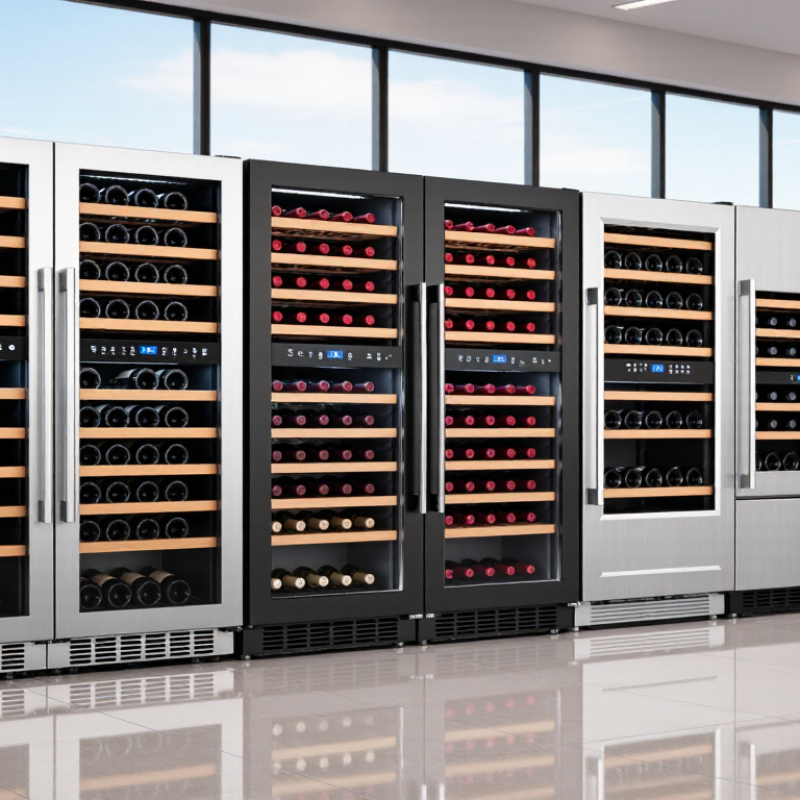
Understanding China’s Wine Refrigerator Manufacturing Industry
China’s wine refrigerator industry draws on a much larger appliance-manufacturing base. The National Bureau of Statistics of China reported roughly 96.3 million household refrigerators produced in 2023. That figure excludes a separate wine-cabinet count, so it should not be read as wine-fridge output. Still, it reflects a broad supply network for compressors, insulation, glass doors, sheet-metal parts, and electronic controls. Scale matters.
Wine cabinets need different priorities from everyday refrigerators. Stable temperatures, low vibration, and even airflow matter when bottles sit for months. A quiet compressor is useful, but it cannot compensate for uneven cooling. Buyers should ask suppliers for temperature-mapping results, loaded-cabinet test records, and details on insulation thickness. Small details count.
China’s manufacturing depth can support custom sizes and production volumes, yet factory capacity alone says little about consistency. Request sample units and compare temperatures across shelves after the cabinet has run under realistic load. Check door seals, rack movement, and the clarity of the control display. Paperwork can look tidy. Independent testing and traceable production records offer stronger evidence, especially when market reports group wine coolers with broader refrigeration categories.
Key Qualities of a Reliable Wine Refrigerator Supplier
Who Are the Best Wine Refrigerator Suppliers in China?
Key Qualities of a Reliable Wine Refrigerator Supplier
A reliable supplier can show how each cabinet performs, not just how it looks in a catalogue. Ask for temperature-uniformity results from loaded-unit tests, plus records of vibration, noise, and temperature recovery after the door opens. Check whether the test conditions and measuring equipment are documented. Clear evidence matters more than impressive promises. Look for stable production processes, trained quality staff, and practical access to replacement parts.
The International Organisation of Vine and Wine’s 2024 report estimated global wine production at 237 million hectolitres in 2023, about 10% below 2022. That figure describes the wider market, not refrigerator quality, but it underscores why buyers should assess suppliers carefully. Request a sample inspection, a written warranty, and clear service-response terms. Ask how the supplier handles defects found after shipment. Even a polished factory tour can miss problems in everyday quality control.
Tips: Ask for test reports from the actual model, not a similar cabinet. Verify temperature readings independently; small differences can matter. Then check spare-part availability and lead times in writing.
How to Evaluate and Compare Chinese Suppliers
When comparing Chinese wine refrigerator suppliers, request evidence from the production line, not just polished product photos. Ask for the same unit’s temperature-recovery test, annual energy-use result, noise reading, and inspection records. Check how the cabinet performs in a warm room, with bottles loaded, and after repeated door openings. Small details matter: shelf spacing, door-seal contact, and whether replacement parts are stocked. Numbers matter.
Market figures offer context, not a buying shortcut. The International Organisation of Vine and Wine reported global wine consumption of 221 million hectolitres in 2023, down 2.6% from 2022. That shift makes flexible order quantities and clear lead times worth discussing.
The International Energy Agency’s 2018 Future of Cooling report projected global energy demand for space cooling to more than triple by 2050. This is not a wine-cabinet forecast, but it reinforces the need to compare measured energy use, rather than marketing claims.
I would also compare sample units against written specifications and inspect a pilot batch before a large order. One sample can look excellent. It cannot prove consistency. I have learned that a tidy checklist still misses issues, so record defects and corrective actions after each inspection.
Notable Wine Refrigerator Suppliers in China
Notable wine refrigerator suppliers in China are best assessed by manufacturing capability, not catalogue size. Some specialize in finished cabinets; others focus on OEM or ODM production, temperature controls, glass doors, and cooling components. This distinction matters. Buyers should ask whether a supplier can provide compressor and thermoelectric models, stable temperature-zone control, and installation drawings for built-in units. Check test records for temperature consistency, vibration, noise, and energy use. Ask for evidence.
Demand context is useful, but it does not prove a factory’s quality. The OIV’s State of the World Vine and Wine Sector in 2023 estimated global wine consumption at 221 million hectolitres, 2.6% below 2022. For suppliers, this points to a market where product fit and dependable production matter more than broad claims about growth. Request current production capacity, sample lead times, and inspection procedures, then compare them with the intended order size. A polished sample can still hide uneven batch consistency; one showroom unit is not proof. Details matter. Check how shelves slide under load, whether seals sit flush, and whether the control panel remains readable in a dim room. These small checks make supplier comparisons more concrete.
Choosing the Right Supplier for Your Needs
Choosing a wine refrigerator supplier in China starts with matching the cabinet to its real use. A restaurant may need frequent door openings and stable recovery, while a home cellar may prioritize quiet operation. Ask for temperature-uniformity test results, not just the advertised set point. Check the number and placement of sensors, the compressor’s operating range, shelf load capacity, and insulation thickness. Details matter. Request a pre-production sample and run it in a warm room; a short factory test may miss vibration, condensation, or uneven cooling. I would not rely on glossy photographs alone.
Supplier checks should include production records, component traceability, inspection procedures, and a written warranty process. Ask how units are packed for export, and request photos of carton drop-test results or packaging validation. The International Energy Agency’s 2018 report, The Future of Cooling, projects that global energy demand for space cooling could more than triple by 2050. This is a broad cooling-sector forecast, not a wine-refrigerator estimate, but it makes operating efficiency worth checking. Compare measured energy use under a stated test method, rather than comparing numbers with different conditions. Finally, clarify spare-part lead times and response channels before ordering. One detail can be missed: suppliers may quote the same capacity but measure bottle storage differently. Get the loading plan in writing.
Who Are the Best Wine Refrigerator Suppliers in China? — Choosing the Right Supplier for Your Needs
Compare suppliers by checking whether their refrigerators can reliably maintain the temperature ranges suited to the wines you serve.
The chart shows typical serving-temperature ranges, not long-term storage settings. Recommendations vary by wine and preference; confirm a refrigerator’s usable temperature range and stability with each supplier.
