
What Is the Best Smart Photo Booth in 2026?

Choosing the best Smart Photo Booth in 2026 means looking beyond touchscreen size and flashy effects. Event hosts need dependable capture, quick sharing, and a setup that suits their space. A crowded booth that produces slow uploads can frustrate guests, even when its camera looks impressive.

Grand View Research’s Photo Booth Market Size, Share & Trends Analysis Report estimated the global market at USD 818.4 million in 2023, with projected growth through 2030. That forecast suggests rising commercial interest, but it does not prove that any particular model performs well. There is a catch. Market growth measures a category, not the quality of a guest’s experience.

A useful comparison should examine image consistency, lighting, print options, sharing controls, software reliability, and support. Check how the booth handles a dim venue, a busy queue, or a weak Wi-Fi connection. These details matter at a wedding reception, product launch, or brand activation. Ask vendors for sample galleries and a live demonstration, then confirm what is included in the quoted price. Do not rely on feature lists alone.

The right choice depends on your event, budget, staffing, and audience. Some booths offer extensive customization but need more setup; simpler models may be easier to run. Neither is automatically better. This guide compares practical strengths and limitations, while treating vendor claims as claims to verify—not guarantees.
What Is the Best Smart Photo Booth in 2026?

What Defines a Smart Photo Booth in 2026?

A smart photo booth in 2026 does more than take a sharp picture. It connects dependable lighting, a responsive touchscreen, thoughtful image processing, and quick delivery by text, email, or QR code. Guests should be able to see a preview, retake a frame, and understand what happens to their images. Small details matter: a bright screen can be hard to read in sunlight, and a weak connection can stall a busy queue. That matters.

AI can help with background changes, cropping, and simple effects, but it should serve the guest rather than slow the session. McKinsey’s 2024 global survey found that 65% of respondents’ organizations regularly used generative AI in at least one business function. That signals growing familiarity, not proof that every booth needs AI. Not magic. The Cisco 2024 Data Privacy Benchmark Study reported that 94% of surveyed organizations believed customers would not buy from a company that failed to protect data properly. A credible booth therefore explains image storage, offers clear deletion controls, and avoids collecting details it does not need. Operators should test skin tones, group shots, low light, and offline delivery before an event. Some effects still look uneven. That is worth admitting.

What Is the Best Smart Photo Booth in 2026?

What defines a smart photo booth? Use these practical criteria to assess one.

A smart photo booth combines dependable image capture with automated customization and easy sharing. This 100-point weighting is an editorial buying rubric, not a market survey or a ranking of products.

How Smart Photo Booths Capture, Process, and Share Images

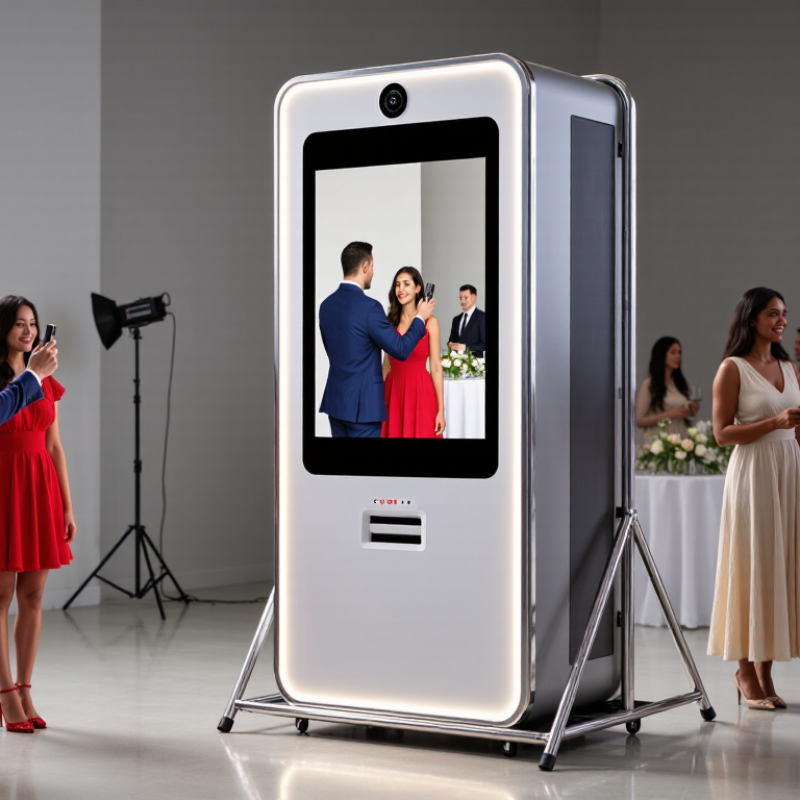
A smart photo booth is more than a camera behind a screen. Its capture stage combines a camera, steady mount, touchscreen, and controlled light. A preview helps guests adjust their posture before the shutter fires. Soft front lighting can reveal faces without washing out pale clothing. Light matters. Focus and exposure should respond quickly when people step into the frame.

After capture, software checks the image, applies selected effects, and prepares a shareable file. Some booths smooth skin or brighten shadows, but restraint usually keeps faces recognizable. A clear preview gives users a chance to retake a blink or awkward pose. Processing should feel quick, yet not hide what changed. That is harder than it sounds. Network delays, dim rooms, or crowded backgrounds can still spoil a polished result. Not every frame.

Sharing may use a QR code, email, or text link, depending on the setup. A good system explains where images go and offers simple controls for saving or deleting them. Staff should test the booth under actual venue lighting, not only in a bright office. That practical check often matters more than another filter. I would not call any booth flawless; automatic cropping can cut off a raised hand. A quick human review helps catch these small misses.

What Is the Best Smart Photo Booth in 2026? — How Smart Photo Booths Capture, Process, and Share Images

A practical comparison of common smart photo booth capabilities. The best setup depends on the event, lighting, guest volume, connectivity, and desired image quality.

Stage Capability Typical Planning Range What It Means for an Event What to Check
Capture Camera resolution About 12–24 megapixels for many interchangeable-lens camera setups Provides enough detail for digital sharing and many standard photo prints. Confirm the delivered image size and whether the booth saves full-resolution files.
Capture Lighting Continuous LED lighting or a flash, adjusted to the venue Consistent, diffused light helps reduce harsh shadows and improve exposure in dim spaces. Ask whether lighting can be tested and adjusted for the event’s room and backdrop.
Capture Guest session time Often around 5–15 seconds per pose, excluding queue time Short prompts and a simple countdown can keep a line moving smoothly. Test the full guest flow, including retakes, props, and group photos.
Processing Basic image processing Usually a few seconds for resizing, color adjustments, and template overlays Can add event graphics or a frame before the image is delivered. Check that text, logos supplied by the event organizer, and borders remain clear at print size.
Processing AI-assisted effects Processing time varies; background removal and generative effects may take several seconds or longer Can create stylized looks or isolate subjects, but results depend on lighting, pose, and processing method. Review sample outputs and confirm whether effects run locally or require an internet connection.
Processing Image file size JPEG files are commonly a few megabytes; file size varies with resolution and image detail Smaller files are generally quicker to send, while higher-quality files are useful for printing or archiving. Ask which file format and quality setting guests receive.
Sharing QR-code delivery Can open a download page as soon as the image is ready and the connection is available Guests can scan with a phone without entering an email address or phone number. Test the QR code on common phones and check how long the download link remains available.
Sharing Email or text delivery Typically depends on internet access, delivery service response, and recipient details Offers a direct route to the image but may require guests to provide contact information. Check consent wording, data handling, and what happens if a message is delayed or fails.
Reliability Offline operation Capture can often continue offline; online delivery features may pause until connectivity returns Local saving helps protect the capture workflow during temporary network interruptions. Confirm local storage, backup procedures, and how queued images are shared later.
Selection Best-fit setup Choose based on guest volume, print needs, effects, venue lighting, and network quality A reliable, easy-to-use workflow is often more valuable than extra effects guests may not use. Request a full demonstration from capture through delivery, not just sample images.

Ranges are general planning estimates, not guaranteed specifications. Actual performance varies by camera, software, image settings, venue conditions, and network connection.

Which Features Matter When Comparing Smart Photo Booths?

What Is the Best Smart Photo Booth in 2026?

Which Features Matter When Comparing Smart Photo Booths?

A good booth keeps the queue moving without making guests feel rushed. Check camera controls, lighting adjustment, and preview speed under dim venue lights. Ask how many finished photos it can deliver per hour, not just how large its screen is. Small delays add up.

Test the full guest journey: tap to start, pose, preview, then receive the image by QR code, text, or email. Sharing should still work when venue Wi-Fi is crowded. Look for offline queuing and clear recovery steps. One frozen upload can disrupt the flow. Test it live.

Privacy deserves equal weight. Ask where images are stored, how long they remain, and who can delete them. The 2024 Cost of a Data Breach Report estimated the global average breach cost at $4.88 million; its scope covers organizations broadly, not photo booths specifically. Treat that figure as a reason to check retention limits, access controls, and deletion procedures. Also compare interface height, readable text, and simple controls. A polished demo is not enough. A few awkward questions now may prevent a visible failure later.

How Leading Smart Photo Booths Differ in 2026

In 2026, smart photo booths differ less by their screens than by what happens between the shutter and the guest’s phone. Strong systems combine flattering, adjustable lighting, fast processing, reliable sharing, and simple on-site controls. Grand View Research valued the global photo booth market at $818.4 million in 2023 and projected 9.7% annual growth through 2030. That signals rising interest, not proof that every feature improves an event. A booth that takes crisp portraits but leaves guests waiting for delivery still feels clumsy.

Look closely at workflow. Can guests choose a background, preview a pose, and receive a photo through a QR code without staff intervention? DataReportal’s Digital 2025 report counted 5.24 billion social media user identities worldwide; these are not necessarily unique people. Mobile-ready delivery therefore matters, but so do consent, clear retention settings, and dependable offline operation. Small details count. Ask how the booth handles dim rooms, crowded queues, and weak venue Wi-Fi. Some systems promise clever personalization yet add friction at the busiest moment. I would compare actual setup time and delivery speed, not just the feature list. One honest caveat: published market forecasts describe growth, not photo quality or guest satisfaction.

How to Choose the Best Smart Photo Booth for Your Needs

What Is the Best Smart Photo Booth in 2026?

How to Choose the Best Smart Photo Booth for Your Needs

The best smart photo booth depends on where you will use it and who will operate it. For a wedding, a compact setup with clear prompts and quick sharing may matter most. At a busy event, check how fast it captures and processes each photo. A bright touchscreen helps guests move through the session without needing constant assistance. Small details matter.

Look beyond the camera specifications. Ask whether the booth supports the print size, lighting, and backdrop you plan to use. Check its footprint, power needs, and internet requirements before booking or buying. A feature list can sound impressive, but it does not show how the booth handles a crowded room or a dim corner. Test the interface if possible, and see how easy it is to retrieve images afterward. I would not choose on novelty alone; a complex setup can create more work than it saves.

Tips: Bring a sample backdrop and test the booth in similar lighting. Confirm setup time, image storage options, and what support is available during your event. If guests hesitate at the screen, simplify the steps. A little trial and error may still be needed.

Article Source:

dLED: retail LED lighting
Privacy Overview

This website uses cookies so that we can provide you with the best user experience possible. Cookie information is stored in your browser and performs functions such as recognising you when you return to our website and helping our team to understand which sections of the website you find most interesting and useful.