2026 Best Panel Light Types for Global Buyers?
Choosing the right Panel Light in 2026 requires more than comparing wattage and price. Global buyers must examine efficiency, glare control, lifespan, installation depth, controls, and regional certification requirements. A bright ceiling may still create uncomfortable reflections on a polished desk. That detail matters.
The International Energy Agency reports that lighting represents roughly 15% of global electricity use. Its energy-efficiency analyses also identify efficient lighting as a practical route to reducing building demand. The U.S. Department of Energy’s SSL research reports continue to show strong LED progress, with laboratory efficacy exceeding 200 lumens per watt in advanced packages. However, laboratory performance is not the same as a finished luminaire. Drivers, diffusers, heat, and ceiling conditions reduce real-world results.
This guide compares edge-lit, back-lit, direct-lit, tunable-white, and emergency Panel Light designs for offices, retail spaces, schools, hotels, and industrial interiors. Independent market studies, including Grand View Research and Fortune Business Insights, forecast continued growth in LED lighting through the decade, although their market boundaries and estimates differ. Buyers should treat those forecasts as directional, not guaranteed.
A useful specification sheet should state delivered lumens, efficacy, UGR, color consistency, power factor, driver lifetime, warranty terms, and photometric files. Ask for testing evidence, not attractive claims. No single type wins every project. That is the uncomfortable part. A low-cost edge-lit model may suit a shallow ceiling, while a back-lit model can provide more uniform output and thermal stability. Yet even this comparison needs field validation, because installation quality often decides the final result.
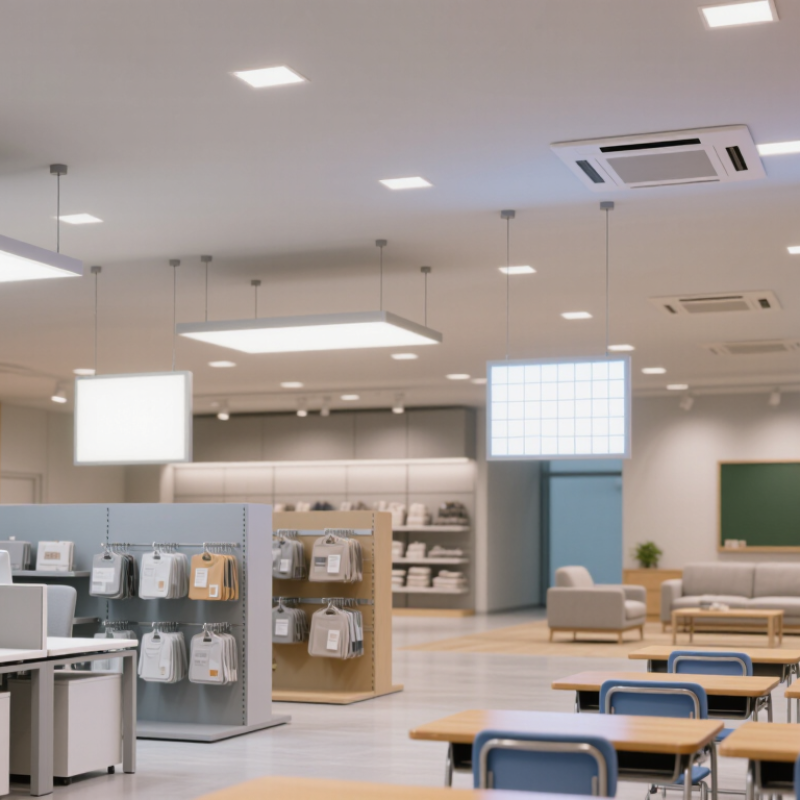
What Are Panel Lights and Why Are They Important in 2026?
Panel lights are flat, wide-area luminaires designed to distribute light evenly. They usually use LEDs behind or beside a thin diffuser. Unlike narrow spotlights, they reduce harsh shadows across desks, classrooms, clinics, and retail aisles. Their clean shape also fits shallow ceilings and modern interiors. In practical installations, uniform light often matters more than maximum brightness.
In 2026, buyers can choose edge-lit, back-lit, recessed, surface-mounted, and suspended panel lights. Edge-lit models are slim and useful where ceiling depth is limited. Back-lit panels may provide stronger optical control and easier thermal management. Recessed units create a neat finish, while surface-mounted versions simplify renovation work. Always check lumen output, glare rating, color consistency, driver quality, and emergency compatibility.
Energy performance remains important, but efficient figures alone can mislead. A panel with poor glare control may cause eye strain in a bright office. I once evaluated a room that had powerful fixtures but uncomfortable reflections on every monitor. The problem was not brightness. It was poor optical planning. Reliable buyers should review test reports, installation conditions, warranty terms, and spare-part access. Motion sensors and daylight controls can reduce wasted electricity, although incorrect settings may annoy occupants. A small trial area is often wiser than ordering hundreds of units immediately.
2026 Best Panel Light Types for Global Buyers
Panel lights are slim LED luminaires designed for even, low-glare illumination in offices, schools, healthcare facilities, retail spaces, and other commercial interiors. In 2026, buyers commonly compare panel-light designs by luminous efficacy, visual comfort, installation flexibility, and energy-management capability.
The chart shows representative luminous-efficacy ranges commonly specified for commercial LED panel-light categories. Actual performance varies by LED package, optical design, driver, color temperature, and product configuration.
Which Panel Light Types Are Available for Global Buyers?
Global buyers can choose from several panel light types, each suited to different ceilings, layouts, and lighting goals. Edge-lit panels use side-mounted LEDs and a thin profile, making them useful for offices with limited ceiling space. Back-lit panels place LEDs behind the diffuser, often producing more even illumination and better long-term heat control. Direct-lit panels are practical for warehouses, schools, and retail areas where efficient general lighting matters.
Mounting options also affect availability and installation cost. Recessed panels create a clean, integrated appearance in modular ceilings. Surface-mounted panels work better on concrete ceilings or finished surfaces. Suspended panels can reduce glare over desks and add visual structure to large rooms. Some suppliers also offer tunable-white panels, allowing users to shift from cool daylight to warmer evening light. RGB versions exist, but they are less suitable for ordinary workplaces. They can complicate controls.
Tips: Check the ceiling system, voltage range, color temperature, UGR rating, driver quality, and local safety certification before ordering. Ask for photometric files, installation instructions, and sample units. A low price can hide weak diffusion or difficult replacement.
From practical project experience, edge-lit models are not always the thinnest total solution after drivers and brackets are included. Back-lit panels may need more ceiling depth, but their light distribution can be easier to verify. Buyers should also question warranty wording and spare-part access. Specifications look precise. Real installations can still differ.
How Do Different Panel Lights Compare in Performance and Cost?
In 2026, panel light selection depends on performance targets, room conditions, and total ownership cost. Edge-lit panels are slim and easy to install in shallow ceilings. Their light distribution can be comfortable, but cheaper models may show darker corners over time. Backlit panels usually provide more even illumination across the diffuser. They also manage heat better when the housing includes adequate ventilation. Direct-lit panels often deliver strong output at a competitive purchase price. However, their deeper profile may require more ceiling space. Check measured efficacy, not only advertised wattage. A reliable test should include illuminance, color consistency, glare, and power consumption.
Cost comparisons should include drivers, installation, replacement labor, and electricity. A 40-watt panel running ten hours daily uses about 146 kilowatt-hours yearly. In areas with high electricity rates, a more efficient panel may recover its higher price sooner. Tunable-white panels add control and support changing visual tasks, but their controls increase setup complexity. They are not always necessary. For offices, low-glare panels with stable color performance often offer better value than feature-heavy options. I have seen buyers focus on the lowest invoice price, then pay more for flicker complaints and early driver failures. That mistake is easy to repeat. Ask for photometric files, warranty terms, operating temperature limits, and samples before ordering globally. Regional voltage, certification, spare parts, and shipping protection can change the real cost significantly.
2026 Best Panel Light Types for Global Buyers?
How Do Different Panel Lights Compare in Performance and Cost?
| Panel Light Type | Typical System Efficacy | Typical Lifespan | Glare Performance | Common CCT / CRI | Typical Input Power
600 × 600 mm | Indicative Unit Cost* | Best-Fit Applications |
| Edge-Lit LED Panel | 100–140 lm/W | 50,000–70,000 hours | UGR <19 models widely available | 3000–6500 K
CRI ≥80; ≥90 optional | 30–45 W | US$18–45 | Offices, classrooms, retail areas, general commercial lighting |
| Back-Lit LED Panel | 110–160 lm/W | 50,000–80,000 hours | UGR <19 models available; uniform output | 3000–6500 K
CRI ≥80; ≥90 optional | 30–40 W | US$20–50 | Energy-conscious offices, schools, hospitals and large projects |
| Direct-Lit LED Panel | 105–150 lm/W | 50,000–70,000 hours | Usually UGR 19–22; diffuser design is important | 3000–6500 K
CRI ≥80; ≥90 optional | 30–45 W | US$15–40 | Warehouses, corridors, utility rooms and cost-sensitive projects |
| Tunable-White LED Panel | 90–130 lm/W | 50,000–70,000 hours | UGR <19 models available | 2700–6500 K
CRI ≥80; ≥90 optional | 35–50 W | US$45–100 | Healthcare, education, hospitality, offices and human-centric lighting |
| Dimmable LED Panel | 95–140 lm/W | 50,000–70,000 hours | UGR <19 models widely available | 3000–6500 K
CRI ≥80; ≥90 optional | 30–45 W | US$25–60 | Meeting rooms, offices, classrooms and spaces requiring lighting control |
| Emergency LED Panel | 90–130 lm/W | 50,000–70,000 hours | Depends on the optical diffuser and emergency mode | 3000–6500 K
CRI ≥80 | 30–45 W
Emergency output varies | US$35–80 | Commercial buildings requiring maintained or non-maintained emergency lighting |
| IP-Rated LED Panel | 90–135 lm/W | 50,000–70,000 hours | UGR performance depends on the sealed diffuser | 3000–6500 K
CRI ≥80 | 30–50 W | US$35–90 | Bathrooms, food-processing areas, healthcare spaces and humid environments |
Buyer Notes
*Indicative unit costs are typical international market ranges for a 600 × 600 mm LED panel fixture, excluding installation, taxes, certification fees, shipping and project-specific controls. Actual prices vary by order quantity, housing material, driver quality, certification requirements and control interface.
Efficacy is measured in lumens per watt (lm/W). UGR refers to Unified Glare Rating; lower values generally indicate better visual comfort. For office and screen-based applications, buyers commonly specify UGR <19, CRI ≥80 and flicker-controlled drivers, subject to local lighting standards.
What Standards Should International Buyers Check Before Purchasing?
For global buyers, panel light selection begins with compliance, not appearance. The right standard depends on the destination, installation method, and electrical system. Check IEC 60598-1 for general luminaire safety and the relevant product-specific requirements. Recessed models may need different installation evidence than surface-mounted models. Confirm rated voltage, frequency, insulation class, and protection against electric shock.
Request complete test reports, not only a certificate image. Useful checks include electromagnetic compatibility, conducted emissions, immunity, and harmonic current performance. Standards such as IEC 55015, IEC 61547, and IEC 61000 series may apply. Verify photobiological safety under IEC 62471, especially for offices, schools, and long-use areas. Ask for measured lumen output, color temperature, color rendering, power factor, flicker data, and lifetime conditions. Numbers can be misleading without test temperatures.
Environmental and market rules also deserve attention. Confirm RoHS and other chemical restrictions required in the importing region. Check whether the product needs local conformity marking, registration, energy labeling, or a recognized certification route. The installation area matters too. A humid ceiling may require a suitable IP rating, while emergency lighting needs separate performance evidence. Do not accept copied laboratory reports.
A practical mistake is trusting a high efficacy figure without checking driver quality and maintenance assumptions. Standards help, but documents can still be incomplete. Compare the report model number, driver details, production version, and sample date. Even experienced buyers miss small differences. That gap deserves careful review.
